What Are Cobots?
Collaborative Robots Explained
What collaborative robots actually are, what they're good at,
and the jobs they're the wrong tool for.
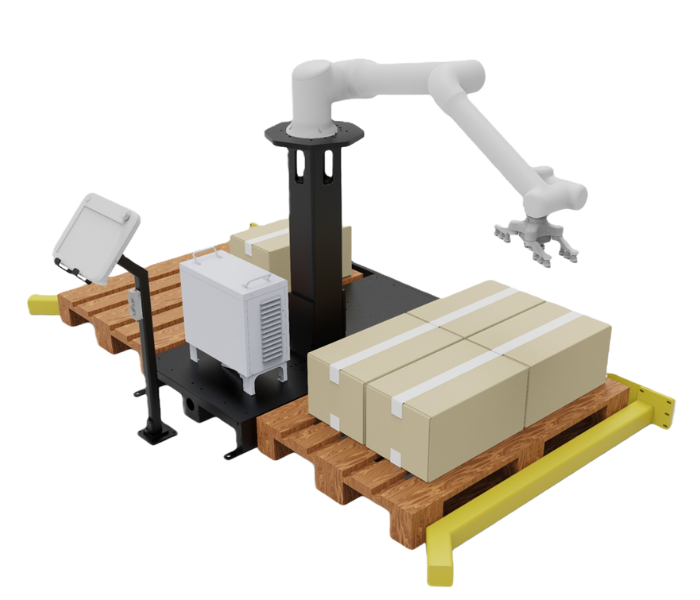
Ask three people what a cobot is and you'll get three answers: a small robot arm, a robot without a cage, a robot that's safe around people. Each is partly right, and the gaps between them are where a lot of bad buying decisions start.
A cobot, short for collaborative robot, is a robot arm designed to work in the same space as people, without the fixed guarding a conventional industrial robot normally needs. It manages this with built-in sensing that limits how hard and how fast it moves, and it stops when it meets unexpected resistance.
That's the definition. The rest of this guide is about what it means on a real factory floor: what cobots do well, where they fall short, and why the arm turns out to be the smallest part of a working automation cell.
"Collaborative" describes how the robot arm behaves. It says nothing about whether your application is safe.
Cobots vs Industrial Robots: What You Trade
A traditional industrial robot is fast, strong and precise, and it lives behind a fence. It's usually installed in a guarded cell with safety interlocks, engineered by specialists around one job, and left alone to run that job for years. For high-volume production of a single product, that's hard to beat.
A cobot gives up some of that speed and payload and gets flexibility in return. It can be set up quickly, moved to a different job, and taught by someone who isn't a robot programmer. In plenty of applications it can be placed without full guarding. For a shop that changes jobs often, those trade-offs usually favour the cobot. For a line making one thing flat out all day, they often don't.
💡 Quick Facts
• A cobot limits its own force and speed so it can share space with people
• Payload depends on the model, from a few kilograms up to around 30 kg on larger current arms
• In collaborative mode a cobot is usually slower than a guarded industrial robot doing the same motion
• Many are taught by hand-guiding the arm or through a touchscreen rather than by writing code
What "Collaborative" Doesn't Mean
This is the point most explainers skip. The arm can be collaborative while the application isn't. A cobot carrying a welding torch, a laser, a sharp tool or a heavy part moving quickly still creates hazards that the arm's force limiting doesn't cover.
Safety gets assessed for the whole application, under ISO 10218 and the ISO/TS 15066 guidance on collaborative operation (check the current editions for your region). We cover how that plays out for welding and machine tending, and when guarding becomes necessary, in the cobot safety enclosure guide.
Where Cobots Earn Their Place
The jobs where cobots pay back fastest share a pattern: repetitive, consistent, and tedious for a person to do for eight hours. Five come up again and again.
• Machine tending
Loading blanks into a CNC machine and taking finished parts out. The geometry is consistent and the result is easy to measure in spindle uptime. See CNC machine tending automation.
• Palletizing
Stacking finished goods at the end of a line, usually the last heavy-lifting task left on the floor. See robotic palletizing.
• Welding
Repeatable torch paths for brackets, frames and fabrications, always with guarding. See the EasyWeld Station.
• Dispensing
Applying adhesive or sealant along a consistent path. See robotic dispensing.
• Assembly and handling
Picking, placing and fitting parts between stations. See assembly automation.
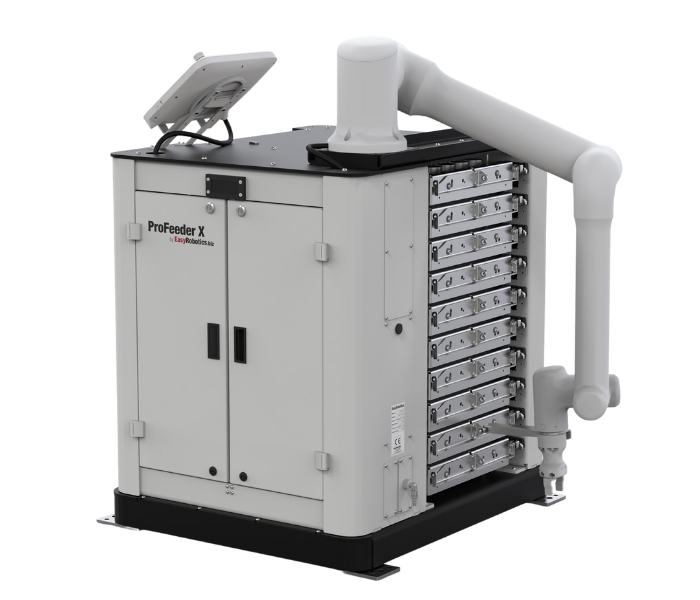
A cobot paired with a feeder: the arm moves the part, the platform supplies it
Where a Cobot Is the Wrong Tool
It's worth saying plainly, because it saves everyone time. A cobot is usually the wrong choice for very high-speed, single-product lines where a guarded industrial robot completes each cycle faster. It's wrong when the load, including the gripper, is beyond what the arm is rated for. It's wrong when a task needs a person's judgement in the middle of a cycle. And it's wrong for truly one-off work, where the programming time is longer than the job.
If your job sits on the edge of those limits, a customised automation solution is the better conversation. EasyRobotics engineers will tell you honestly if a standard cell isn't the right fit, at no charge.
The Arm Is the Smallest Part of the Cell
Buyers tend to compare arms and underestimate everything around them. A bare arm needs a stable mount, a way to receive parts, a way to open the machine door, guarding where the process calls for it, and a program that someone on your floor can change next month. That surrounding hardware is what turns an arm into a working cell.
It's the part EasyRobotics builds: workstations and pedestals to carry the robot, ProFeeder platforms to supply parts, the EasyDoor to open a CNC machine's door, and palletizing stations for the end of the line. It works across Universal Robots, Doosan, FANUC CRX, ABB, KUKA, Hanwha and others, so the arm is a separate choice. Compatibility depends on the specific product and robot, so confirm it for your combination. The cobot brand compatibility guide explains how to think about that choice.
✅ Questions Worth Asking Before You Buy a Cobot
• What will it pick up, and what does the heaviest part weigh once the gripper is included?
• Does the task involve a hazard of its own, such as an arc, a laser or sharp tooling?
• How long should it run without someone standing nearby?
• How often will the part change?
• Who on your floor will reprogram it next month?
If you're ready to look at the numbers, the cobot automation ROI guide and the ROI calculator let you test a job against your own shifts and costs.
Frequently Asked Questions
Conclusion
A cobot is a robot arm built to share space with people, and that one design choice is what makes it quick to deploy and easy to move. It doesn't make every application safe, and it doesn't make the arm the whole solution.
Start from the job: what's being moved, how heavy it is, how often it changes, and how long it should run unattended. The right cobot, and the right cell around it, usually becomes clear from those answers.
Wondering If a Cobot Fits Your Floor?
Tell an EasyRobotics specialist about the job you want to automate.
We'll say honestly whether a cobot is the right tool — at no charge.