Do You Actually Need a Cobot Safety
Enclosure? Here's How to Tell
A practical guide to guarding collaborative robot cells for welding, laser,
and machine tending applications.
One of the first questions we get from a manufacturer bringing in their first collaborative robot is some version of the same thing: "Do we need to put a cage around it?" It's a fair question, and the honest answer is: it depends on what the robot is doing, not on the fact that it's a cobot.
A lot of the appeal of collaborative robots comes from the promise that they can work alongside people without fencing. That's true for a genuine pick-and-place task running at moderate speed with a light payload. It stops being true the moment you strap a welding torch, a laser head, or a sharp gripper to the end of the arm. At that point, the hazard isn't the robot's motion anymore — it's the process the robot is carrying out.
Cobot safety enclosures exist to cover exactly that gap: process-level hazards that power-and-force limiting alone can't address. Getting the guarding decision right matters for two reasons — getting it wrong in one direction creates a compliance and injury risk, and getting it wrong in the other direction means paying for, and living with, a full cage around a cell that never needed one.
A collaborative robot is only as "collaborative" as the task attached to it. The arm can be inherently safe; the torch, the laser, and the tooling usually aren't.
What ISO 10218 and ISO/TS 15066 Actually Ask You to Do
Neither standard hands you a yes/no answer on guarding. ISO 10218 covers the safety requirements built into the robot and the system around it, while ISO/TS 15066 adds the technical detail on collaborative operation — including the power and force limits a robot needs to stay under for contact with a person to be considered acceptable. What both documents actually require of you is a task-based risk assessment.
In practice, that assessment looks at the end effector and the process, not just the robot arm. A UR5e moving a plastic tray at reduced speed is a very different risk profile from the same arm carrying a MIG welding torch, even though the robot itself is identical. The assessment is what tells you whether power-and-force limiting is enough on its own, or whether you need to add physical guarding, interlocked doors, light curtains, or some combination of all three.
As a rule of thumb, guarding tends to become necessary — not optional — once any of the following enter the cell: an arc or laser light source, sharp or hot tooling, a payload heavy enough to cause injury even at reduced speed, or a cycle that requires the robot to move faster than collaborative speed limits allow. Welding and laser-based processes fall into this category almost every time, which is why EasyRobotics builds guarding directly into its welding cell offering rather than treating it as an accessory.
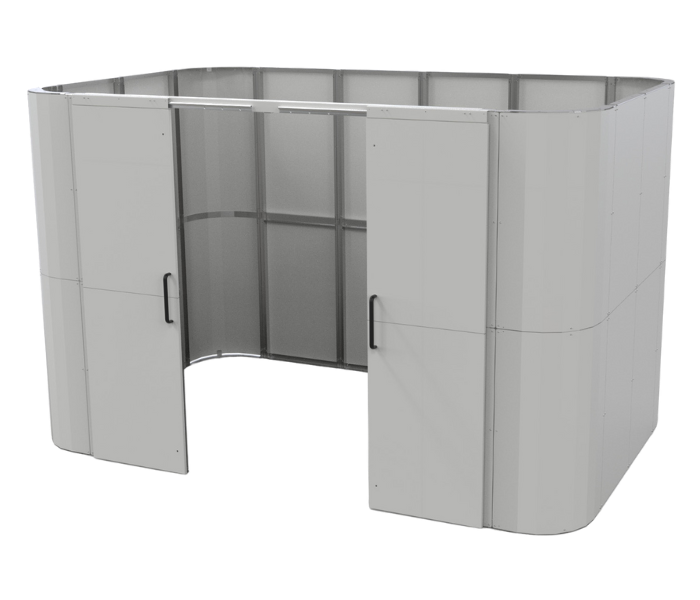
EasyEnclosure — 3mm steel frame, double sliding doors, L2400 × W3800 × H2383 mm
What Skipping Guarding Actually Costs You
Under-guarding a cell rarely shows up as a single obvious failure. It tends to surface across a few different areas at once, most of which only become visible once something has already gone wrong.
• Insurance and Audit Exposure
Insurers and third-party auditors increasingly ask for documented risk assessments on any robot cell involving welding, laser, or high-payload tasks. A missing or unconvincing assessment can complicate a claim or hold up a certification, independent of whether an incident ever occurs.
• Operator Confidence and Adoption
Operators who don't trust the guarding around a cell tend to keep their distance from it, defeating the point of collaborative deployment. Visible, well-built enclosures with clear sightlines — rather than improvised barriers — tend to get faster buy-in on the shop floor.
• Rework After the Fact
Retrofitting guarding onto a cell that's already running production is more disruptive than specifying it up front. It means downtime to install, re-validate, and re-train around a layout that was never designed to accommodate a cage.
• Process Quality Side Effects
For laser and some welding processes, the enclosure isn't just a barrier against contact — it also controls stray light and fume dispersion. Skipping it can mean inconsistent results even before you get to the safety question.
💡 Quick Facts
• EasyEnclosure's 3 mm steel frame and double sliding doors fit around 90% of cobot welding cells at L2400 × W3800 × H2383 mm
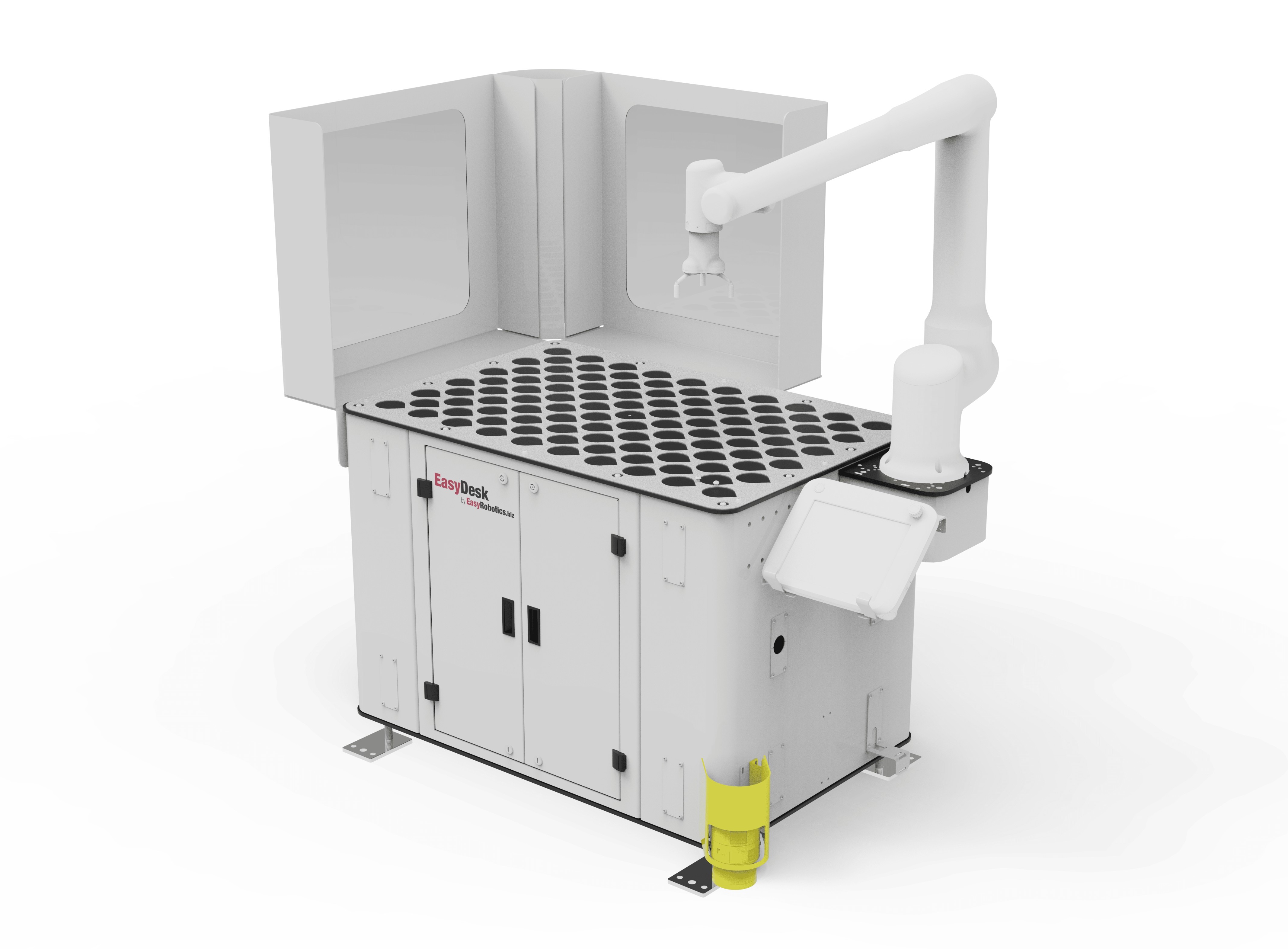
• The EasyDesk Safety Enclosure attaches to or detaches from an existing EasyDesk workstation, so guarding can be added later
• EasyDesk enclosure options include lockable access doors, safety interlocks, and optional light curtains
• The FlexiGuard Tending Station ships with guarding built into a mobile CNC tending cell, rather than as a separate add-on
Three Guarding Options, and Which Applications They Fit
EasyRobotics offers guarding at three different levels, depending on whether you're building a standalone welding cell, adding protection to an existing workstation, or automating a CNC machine that needs the guarding built in from the start.
EasyEnclosure — Standalone Welding & Laser Cell
The EasyEnclosure is a self-contained modular cell built for collaborative welding and laser processing. It's constructed from solid 3 mm steel and fits comfortably in small workshop footprints at L2400 × W3800 × H2383 mm, with double sliding doors for access even where floor space is tight. EasyRobotics sizes it to cover roughly 90% of collaborative welding cell layouts out of the box, and it's engineered to meet international laser-safety and industrial safety requirements.
EasyDesk Safety Enclosure — Modular Add-On Guarding
Where a cell is already built around an EasyDesk workstation, the EasyDesk Safety Enclosure attaches around it rather than requiring a separate structure. It combines a steel frame with transparent polycarbonate panels, so operators keep full sightlines into the process while the risk assessment's guarding requirement is satisfied. Lockable access doors, safety interlocks, and optional light curtains bring the setup in line with ISO 10218 and ISO/TS 15066, and because the panels are modular, they can be added, repositioned, or removed as the task changes.
FlexiGuard Tending Station — Guarding Built Into a Mobile Cell
For CNC machine tending, guarding needs are usually driven by the machine and workpiece rather than a welding arc. The FlexiGuard Tending Station folds built-in safety guarding into a mobile, castor-mounted tending cell (model FG-1000-T, H 2420 × W 1330 × L 2213 mm, 800 kg, with a 1000 × 1500 mm tending grid plate), so the guarding travels with the cell when it's relocated between CNC machines instead of needing to be rebuilt at each new position.
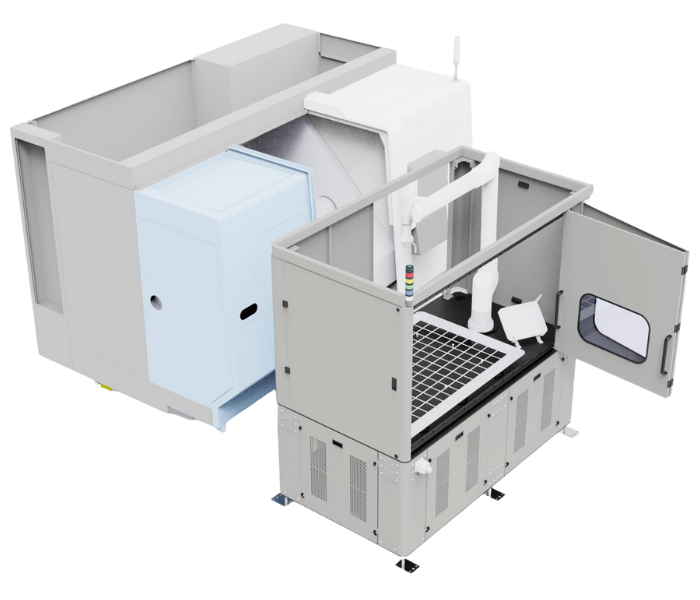
FlexiGuard Tending Station — mobile CNC tending cell with guarding built in, FG-1000-T
A Quick Way to Decide Which One Fits
If you're still working through the decision, these questions tend to sort most cells into the right category quickly.
Are you welding or using a laser process? Start with the EasyEnclosure if you're building the cell from scratch, or the EasyDesk Safety Enclosure if you already have an EasyDesk workstation in place and just need to add guarding around it.
Are you tending a CNC machine? The FlexiGuard Tending Station is built for exactly this, with the guarding already integrated into the mobile cell rather than sourced separately.
Is the cell doing simple, low-speed handling with a light payload and no hazardous tooling? Your risk assessment may conclude that power-and-force limiting is sufficient without physical guarding — but that conclusion should be documented, not assumed.
✅ Guarding Is Almost Always Required If Your Cell Has…
• A welding arc, laser, or other light-emitting process
• Sharp, hot, or otherwise hazardous end-of-arm tooling
• A payload heavy enough to cause injury even at reduced speed
• Cycle speeds that exceed collaborative operating limits
• Fume, spatter, or stray light that needs to be physically contained
If your application doesn't map cleanly onto EasyEnclosure, EasyDesk Safety Enclosure, or FlexiGuard, EasyRobotics engineers can review the layout and hazard profile as part of a customised automation solution, at no charge.
Guarding as Part of a Bigger Automation Plan
Guarding decisions rarely happen in isolation — they're usually made alongside the choice of workstation, tooling, and layout for the whole cell. Because EasyRobotics enclosures share the same modular design language as the rest of the product range, adding or adjusting guarding later doesn't mean starting the cell design over.
Welding Cells: The EasyWeld Station is built around a precision Siegmund welding table and pairs naturally with the EasyEnclosure for a complete, compliant collaborative welding setup.
CNC Machine Tending: Beyond FlexiGuard, EasyRobotics' broader CNC tending range covers everything from compact tray feeders to high-capacity mobile cells, with guarding specified appropriately for each.
Workstations: The EasyDesk range is the most common base onto which the EasyDesk Safety Enclosure is added, giving you a path from an unguarded pick-and-place setup to a fully enclosed cell without swapping out the workstation itself.
Because everything shares the same modular footprint, guarding a cell today doesn't lock you out of expanding or reconfiguring it later.
Frequently Asked Questions
Conclusion
Guarding a cobot cell isn't about distrust in the technology — it's about matching the safety setup to the actual hazard the robot is carrying, whether that's a welding torch, a laser head, or nothing more dangerous than a light plastic tray. Get the risk assessment right first, and the choice between EasyEnclosure, the EasyDesk Safety Enclosure, and FlexiGuard tends to follow naturally.
A well-specified enclosure protects your operators, keeps you audit-ready, and — because EasyRobotics builds guarding on the same modular system as the rest of its automation range — doesn't box you into a layout you can't change later.
Not Sure Which Guarding Your Cell Needs?
Talk to an EasyRobotics automation specialist. Get a risk-assessment walkthrough
and a guarding recommendation for your specific application — at no charge.