How to Choose a Cobot Brand
Without Limiting Your Automation
Compare payload, reach, support and integration requirements—then choose
a workstation that keeps your future automation options open.
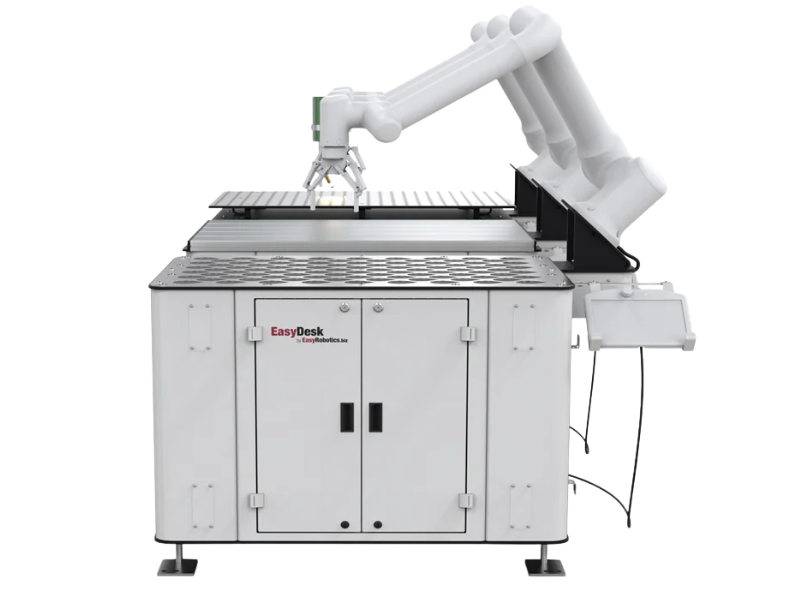
Most automation research starts with the robot: Universal Robots or Doosan? FANUC CRX or ABB? It is a reasonable question, but brand alone does not determine whether a robot is right for an application. Payload, reach, cycle time, local technical support, programming experience, controller integration and safety requirements all need to be evaluated together.
The workstation, tabletop, tray system or pedestal may remain useful for longer than a particular robot model when the platform is designed for multiple robot brands. Choosing a flexible platform can reduce the mechanical changes required for future projects, although every robot-and-workstation combination must still be checked and approved for the intended application.
Choose the robot for the application—and choose a workstation that gives you practical options for future projects.
What Brand-Agnostic Actually Means in Practice
In practice, a multi-brand-compatible workstation depends on several concrete design choices: adaptable mounting interfaces, suitable space for the selected controller, organized cable routing and a tabletop or fixturing surface that can be configured for the robot's actual reach envelope.
Selected EasyRobotics configurations provide 0° or 45° robot mounting options, helping integrators position the robot for the required working area. Available mounting positions, controller storage and compatibility vary by product and robot model, so the complete configuration should be verified before ordering.
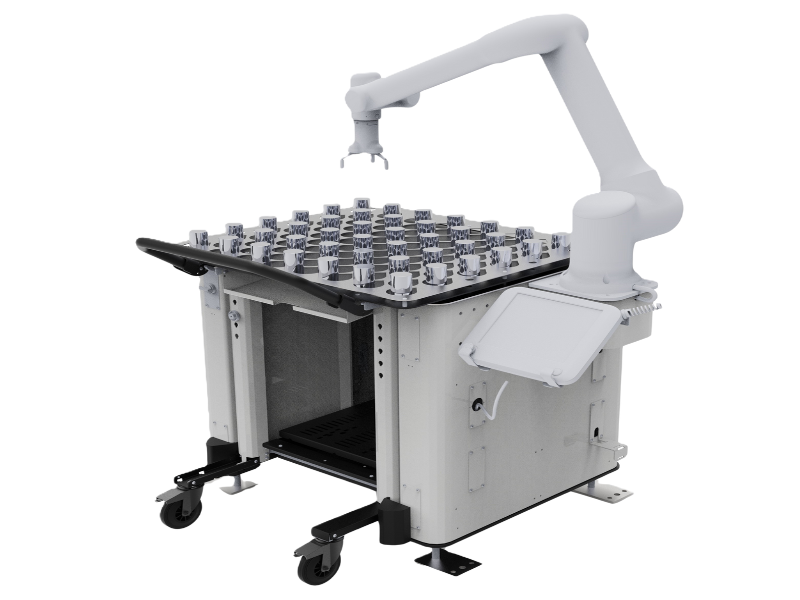
The mounting interface, not the tabletop, is where brand compatibility actually lives
Which Brands Actually Fit EasyRobotics Workstations
EasyRobotics platforms—including EasyDesk, ProFeeder, and EasyPalletizer—are designed for integration with widely used collaborative robots. Exact compatibility depends on the specific workstation, robot model, mounting interface, payload, reach and application. Confirm the complete combination with EasyRobotics before ordering.
This flexibility can help a facility use the same workstation family across different automation projects while selecting the most suitable robot for each task. Mechanical standards and fixturing practices may remain consistent, but programming, controller operation, maintenance procedures and safety validation will still be specific to each robot and application.
💡 Quick Facts
• EasyRobotics platforms are designed for integration with many widely used collaborative robots
• Selected configurations provide 0° and 45° robot mounting options to support application-specific reach
• Mounting interfaces, controller placement and cable requirements vary by product and robot model
• Compatibility should be confirmed per specific product model before ordering
So How Do You Actually Choose a Brand?
With the workstation decision decoupled from the robot decision, choosing a brand comes down to the factors that are genuinely brand-specific: local service and support network, existing familiarity on your floor, payload and reach against your heaviest part, and price at the spec you actually need — not the spec sheet's top-end model.
A flexible workstation reduces dependence on a single robot ecosystem, but changing the robot is still an engineering project. A new arm may require a mounting adapter, controller and cable changes, I/O reconfiguration, tooling checks, application reprogramming, reach and payload validation, an updated risk assessment and recommissioning.
✅ Worth Checking Before You Commit to a Brand
• Local service and spare-parts support in your region
• Payload and reach against your heaviest or largest part, not the average one
• Whether your team already has experience programming that brand's ecosystem
• Confirmed compatibility with the specific EasyRobotics product model you're considering
• Total delivered cost at the spec you need, not the flagship model

Robot and workstation compatibility should be confirmed for the complete palletizing application
When Brand Choice Does Matter More
There are cases where the brand decision carries more weight — a facility standardising fleet-wide on one manufacturer for spare-parts simplicity, a task at the outer edge of payload or reach where only a specific model fits, or a plant with an existing integrator relationship tied to one ecosystem. In those situations, the brand decision reasonably comes first, and a brand-agnostic workstation still accommodates it without any downside.
For unusual payloads, reach requirements, or a robot brand not listed above, a customised automation solution can extend compatibility further — EasyRobotics engineers can confirm fit for your specific arm at no charge.
Frequently Asked Questions
Conclusion
Choosing a cobot is not simply a brand decision. The best choice is the model that meets the application's payload, reach, cycle-time, integration, support and safety requirements. A multi-brand-compatible workstation can preserve more options for future projects and may reduce the need to replace the complete platform.
Evaluate the robot and workstation as one system, confirm the exact combination before ordering and involve a qualified integrator in commissioning and safety validation.
Not Sure Which Robot Brand Fits Your Cell?
Talk to an EasyRobotics automation specialist about your application and preferred robot brand.
Get a compatibility check and a quote — at no charge.