Modular Robotics: What It Means
and How to Choose a Provider
"Modular" is the most used and least defined word in automation.
Here is what it should mean, and five tests to apply to any provider.
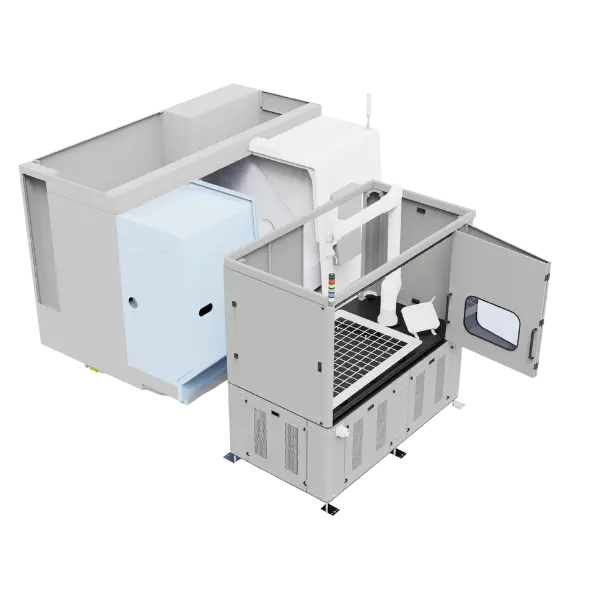
Ask three automation suppliers what "modular" means and you'll get three answers. For one it's a catalogue of standard parts. For another it's a software feature. For a third it's a marketing word attached to whatever they were already selling.
Here is the useful definition. A modular robotic cell is built from standard, pre-engineered units, such as a robot base, a part feeder, a machine door opener, safeguarding or a palletizing station, which can be combined, moved and changed, rather than engineered from scratch for each job.
That definition is easy to state and surprisingly easy to fail. This guide covers what modular can mean, where it fits, five tests to apply to any provider, and where modular is not the answer.
Modular only counts if you can change it later without sending for the supplier's engineers.
Three Things "Modular" Can Mean
• Modular hardware
Standard units that bolt together: a base or pedestal, a feeder, a door opener, a guard, a palletizing platform. The test is whether they're genuinely standard, or custom parts with a catalogue number.
• Modular programs
Reusable programs, recipes or patterns, so a new product means selecting or adjusting a saved setup rather than starting again.
• Modular growth
The ability to add a second cell, move a cell to another machine, or reconfigure a line without rebuilding what's already working.
A provider can be strong on one and weak on the others. The hardware may be standard while every program is bespoke, or the growth story may look good on paper and fall apart when you try to move a cell. Which of the three matters most depends on your plant.
Where Modular Fits, and Where It Doesn't
Modular suits low-to-mid volumes with several product variants, demand that moves around, and a team without a robotics engineer on staff. If you make a few thousand units a month across a handful of variants, the ability to change and relocate a cell is worth more than squeezing out the last second of cycle time.
It's a poor fit for a very high-volume line making one product at maximum speed. There, a dedicated system built around that single product usually wins. And for an unusual process or layout, a modular platform may need adapting, which is where a customised solution comes in.

Mobility is a modular test: can the cell follow the work?
Five Tests for Any Modular Robotics Provider
1. Maintainability
Easy to maintain comes down to standard components, accessible service points, available spare parts, clear documentation and local support. Ask for the service documentation and the spares list before you buy. Fewer consumables help too. The ProFeeder X offers two locking options, and one of them, MechLock, is a manual mechanical lock that needs no compressor, which is one fewer thing to service.
2. Customisation
Find out what you can change yourself, such as trays, fixtures, mounting angles and programs, and what needs the supplier. A provider who says everything is customisable but can't say who does it, or how long it takes, is telling you something.
3. Scalability
Can you add a second cell or move the first? Relocation should be possible, and it should come with a clear recheck of positions, sensors and safeguards afterwards. A cell that moves without anyone checking it isn't a feature, it's a risk.
4. The plug-and-play reality
"Plug and play" rarely covers everything. Ask what it excludes: usually the robot adapter, safeguarding, software setup and commissioning. Our guide to reading a robot cell quote shows how to check.
5. Robot-brand freedom
A modular platform that only accepts one robot brand locks in your next decision. Check which brands each product supports, and confirm your exact model. We explain why this matters in the cobot brand compatibility guide.
✅ Questions to Ask Any Modular Robotics Provider
• Which parts are genuinely standard, and which are custom with a catalogue number?
• Can I see the service documentation and spare-parts list now?
• What can my team change, and what needs your engineers?
• What happens to safeguards and positions when I relocate a cell?
• Exactly what does "plug and play" exclude in this quote?
• Which robot brands and models are confirmed for this product?
Who Provides Modular Robotics?
Several kinds of company do. Some robot makers offer modular platforms around their own arms. Cell builders sell standardised hardware that works across robot brands. And some integrators reuse their own standard designs from project to project. They answer the five tests differently, so judge each one on those, not on the word "modular" in the brochure.
EasyRobotics is a cell builder. It makes standardised cell hardware: workstations, feeders, palletizing platforms, welding stations, guarding and CNC door openers, with more than 1,000 installations across 30+ countries. It works across Universal Robots, Doosan, FANUC CRX, ABB, KUKA, Hanwha, Kassow and others, with compatibility confirmed per product, and sells through partners and directly. You can see the full range on the products page. If you're weighing a supplier against an integrator, our buying guide explains the difference.
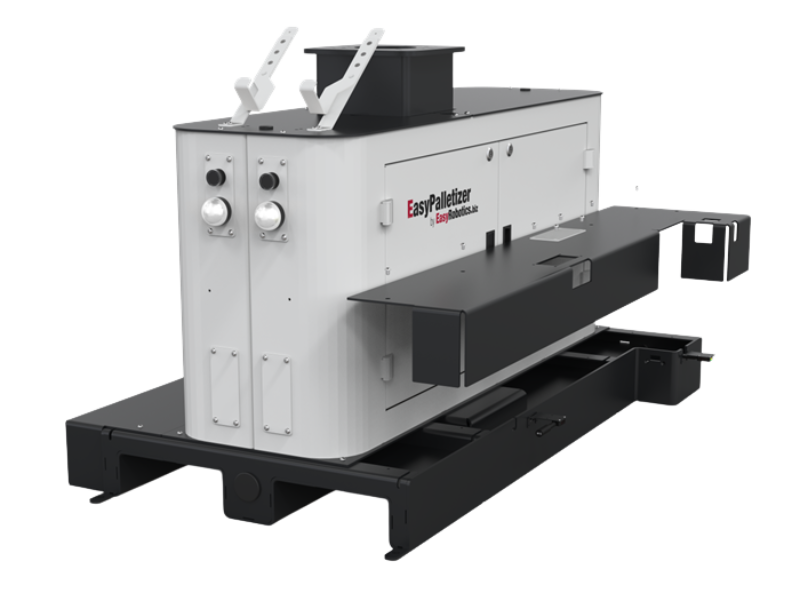
A standard platform: the same unit, configured around the robot and the job
💡 Quick Facts
• A modular cell uses standard units that can be combined, moved and changed
• Modular suits low-to-mid volumes with several variants, not one product at maximum speed
• Hardware scales easily; software and grippers usually follow the product
• Always ask what "plug and play" excludes
Frequently Asked Questions
Conclusion
Modular robotics is a good fit for plants with variety, changing demand and a lean engineering team, and a poor fit for one product at maximum speed. The word itself guarantees nothing, so test the provider on maintainability, customisation, scalability, what plug and play leaves out, and robot-brand freedom.
A provider who answers those plainly, including the awkward ones, is usually one you can work with for years.
Evaluating Modular Robotics Providers?
Tell an EasyRobotics specialist your volumes, variants and machines.
You'll get a straight answer on whether a modular cell fits — at no charge.