Distributor, Integrator or Manufacturer?
Who to Buy Cobot Automation From
Four roles that get blurred together, what each one actually does,
and how to pick the right one for your project.
Search for a "robot distributor" and you'll find that the word means different things to different people. A plant manager typing it usually wants someone to buy from. A systems company typing it often wants to resell. Both are looking at the same industry from opposite sides of the counter.
For buyers, the confusion costs real money. A company that asks a distributor to engineer a custom application will be disappointed. A company that hires an integrator to deliver a standard product will overpay. Most of the trouble comes from not knowing which of four roles you actually need.
Here is what each role does, how to choose between them, and, for readers on the other side of the counter, how partnering with EasyRobotics works.
A distributor sells and supports. An integrator designs and builds. The difference matters more than the price.
The Four Roles in the Robotics Channel
• Robot manufacturer
Builds the arm itself. Most manufacturers sell through channel partners rather than dealing with every end customer directly.
• Distributor
Sells and supports products within a territory. That usually means quoting, local availability, first-line support and training on the product. A distributor is generally not the company that designs your application from a blank sheet.
• System integrator
Designs, builds, programs, safety-assesses and commissions a complete application. The work is project-based, and it's the right call when the job is complex or custom. We touch on this in our piece on industrial robot integration.
• Cell and platform builder
Builds the standardised hardware around the arm: the workstation, feeder, door and palletizing station. Because that hardware is already engineered, the integration work left over is much smaller. EasyRobotics is this kind of company, headquartered in Sønderborg, Denmark.
In practice one company often fills two of these roles, so the useful question isn't what a company calls itself. It's which role will own your project when something goes wrong.

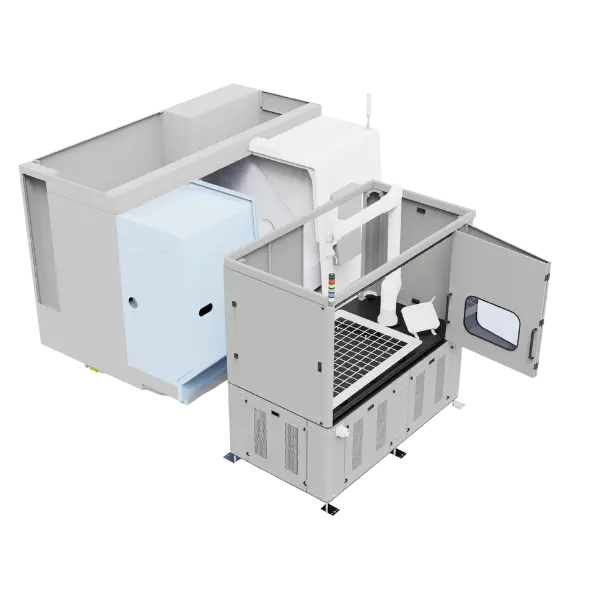
A standard cell like this leans on the distributor role more than the integrator role
Which One Does Your Project Need?
The deciding factor is how much of the job is standard. A familiar task using a pre-engineered cell, such as tending one CNC machine or palletizing a regular carton, needs a good supplier more than it needs a bespoke design. EasyRobotics states that its pre-engineered cells are typically installed and running within 24 to 48 hours, so for these jobs a distributor or a direct quote is often enough.
An unusual part, a hazardous process, or a connection into your line controls is where an integrator earns the fee. Someone has to own the engineering and the safety sign-off, and that's their job. For work in between, a customised solution built on standard modules can keep the engineering small.
💡 A Rough Guide
• Standard task, pre-engineered cell: distributor or direct from the manufacturer
• Unusual part, process hazard or controls integration: system integrator
• Standard modules with some adaptation: a cell builder offering a customised solution
• Several sites or countries: a supplier with a partner network that covers them
Six Questions to Ask Before You Sign
Whichever route you take, these questions separate a supplier who'll still be useful in year two from one who won't. The answers matter more than the quote.
✅ Ask Every Supplier
• Who provides service and spare parts in my country, and how quickly?
• Have you installed this exact application before, and can I speak to that customer?
• Who carries out the risk assessment and signs off safety?
• What training do my operators get, and who reprograms the cell later?
• Which robot brands do you support, and am I locked into one?
• What exactly is in the quote: guarding, gripper, machine door, commissioning?
The brand question deserves a note of its own. A supplier who can only offer one robot brand limits your options for years. Our cobot brand compatibility guide explains why a workstation that accepts several brands keeps the choice open.
How EasyRobotics Sells
EasyRobotics works through a global partner network, shown on the partners map, and also takes quote requests directly. If you're a buyer, check whether a partner covers your country, or contact the team and describe the job. The expert-help form promises a reply within 24 hours.

Modular hardware means a partner can demonstrate and deploy a working cell quickly
If You Want to Be the Distributor
For distributors and integrators weighing a new product line, the appeal of modular, pre-engineered hardware is simple: repetitive applications like tending and palletizing stop needing custom engineering every time. The partner programme is built around four areas of support.
• Partner enablement
Sales playbooks, demo kits and deal support.
• Technical training
Product certification and solution guides.
• Marketing support
Co-branded assets and launch campaigns.
• Territory growth
Lead sharing and partner portal resources.
The process has three steps. You apply with details of your company, territory and portfolio. The channel team reviews coverage and market potential. If it's a fit, you're onboarded with enablement, certification and a go-to-market plan. EasyRobotics usually responds within 2 to 3 business days. You can apply on the distributor page.
Frequently Asked Questions
Conclusion
"Who should I buy from?" has no single answer, because the question hides four different roles. Standard jobs on pre-engineered cells need a dependable seller with local support. Complex or custom jobs need an integrator who'll own the engineering and the safety sign-off.
Decide how much of your job is standard, ask the six questions above, and pay attention to who picks up the phone when the cell stops. If you're on the other side, building a business around cobot automation, the partner route is open.
Buying a Cell, or Selling One?
Describe your project to an EasyRobotics specialist, or apply to join the partner network.
Either way, you'll get a straight answer.