Cobot Welding Table vs Welding Turntable:
Which Fits Your Production?
Stop rebuilding your welding cell for every new part. Compare two practical ways
to improve changeovers, loading and robot arc-on time.
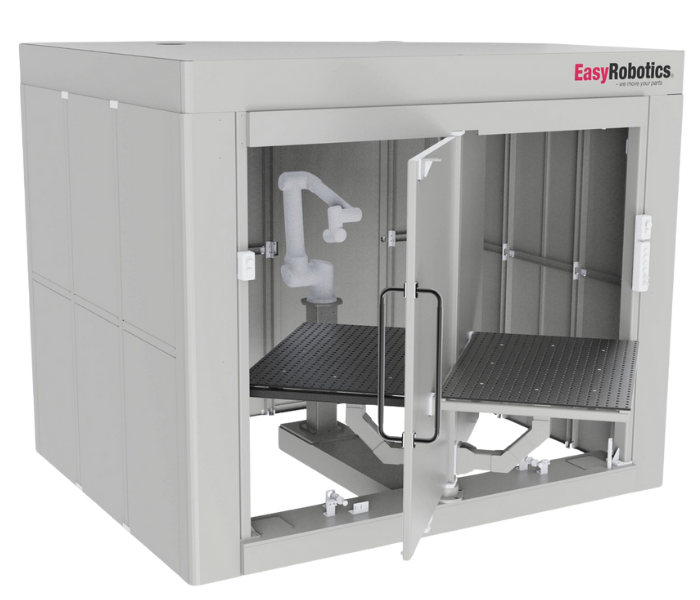
A cobot arm is only as productive as the fixturing it's welding against. Plenty of fabrication shops learn this the hard way: they automate the welding motion, then discover the real bottleneck is the twenty minutes an operator spends repositioning clamps every time a new part comes down the line.
Two approaches solve this, and they solve different versions of the problem. A quick-change welding table — a modular, perforated tabletop with a standardised hole pattern — lets fixtures move fast without new tooling. A welding turntable solves a related but different problem: keeping the robot arc-on continuously by letting an operator load the next part while the robot finishes the current one.
Neither is universally "better" — they answer different questions about how your shop actually runs. Here's how each works, and how to tell which one your cell needs.
If you are still selecting the basic workstation type, read our robotic welding table guide before comparing quick-change and rotary configurations.
A robot that welds fast but waits twenty minutes for a fixture change isn't a fast cell — it's a fast robot in a slow cell.
Quick-Change Tabletops: Flexibility for Mixed Part Families
The EasyDesk Welding workstation (model ED-1002-W, H 970 × W 890 × L 1550 mm, 420 kg) is built around a plasma-nitrided steel tabletop with laser-cut 16 mm holes running the full length of the surface — a perforated fixturing grid rather than a fixed jig. Instead of bolting one dedicated fixture permanently in place, clamps and stops are repositioned into the hole pattern to suit whatever part is running that shift.
That matters most in shops running several related part families through the same cell rather than one product forever. The cobot console mounts at 0° or 45° to keep the full tabletop within reach, and the whole unit is designed to be moved between production setups with a standard pallet lifter rather than being anchored permanently to one spot on the floor.
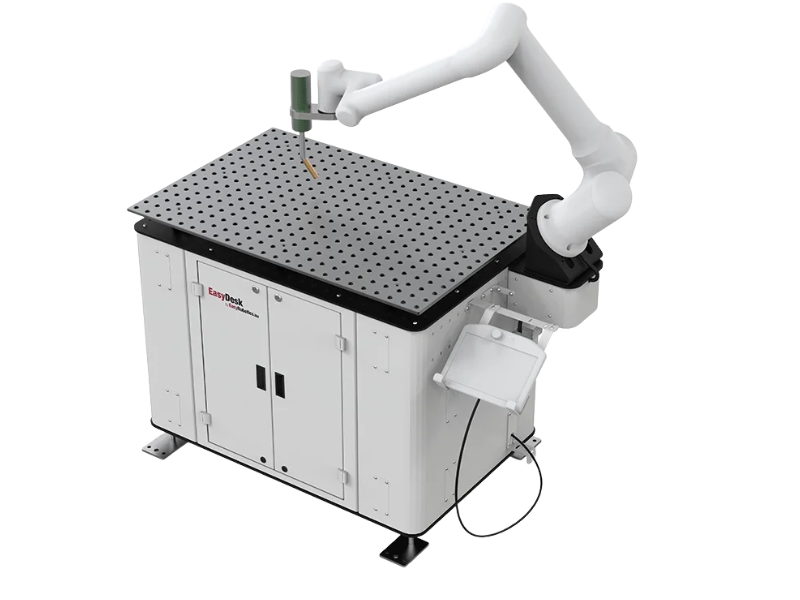
EasyDesk Welding — laser-cut 16mm holes along the full tabletop for fast fixture repositioning
Turntables: Keeping the Arc On While Someone Loads the Next Part
The EasyWelding Turn Table (model ETT-1001, H 2500 × W 2700 × L 2600 mm, 1,900 kg) tackles a different bottleneck. Rather than speeding up fixture changes on a single station, it adds a 180° programmable rotating platform — typically divided into 2 or 4 stations — so an operator loads or unloads one side while the robot welds on the other. The weld plate itself measures 1000 × 1500 mm and supports MIG, TIG, plasma, and spot welding.
The effect is that the robot's welding time stops being interrupted by loading time at all — the two happen in parallel instead of in sequence. For a shop where the real constraint is arc-on time on a smaller number of higher-volume parts, this overlap matters more than fixture-swap speed.
💡 Quick Facts
• EasyDesk Welding: plasma-nitrided perforated tabletop, 1200 × 800 × 12 mm, 16 mm laser-cut holes
• EasyWelding Turn Table: 2 or 4 stations, 180° rotation, 1000 × 1500 mm weld plate
• Both accommodate different part designs by swapping interchangeable fixtures
• EasyWelding Turn Table supports MIG, TIG, plasma, and spot welding processes
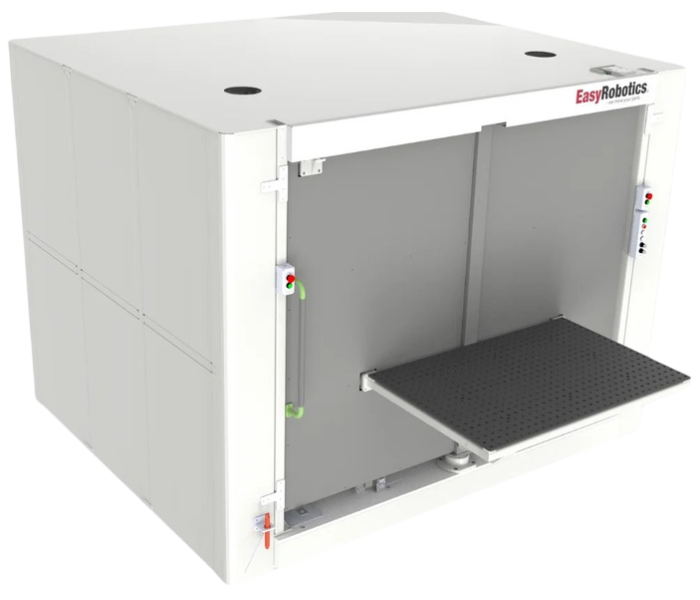
Robot welds one station while an operator safely loads the next — no arc-on interruption
Which One Fits Your Shop?
The honest answer depends on what's actually limiting your throughput today. If your cell spends more time between welds — swapping clamps, repositioning stops, reconfiguring for the next job — than it does welding, a quick-change tabletop addresses that directly. If your cell is welding the same handful of high-volume parts and the robot is genuinely idle waiting for an operator to load and unload, a turntable's parallel loading is the bigger lever.
Some shops eventually want both: a turntable's dual-station loading rhythm with a fixturing surface that can still be reconfigured between product runs. That's a case where a customised cell layout, rather than an off-the-shelf single product, tends to make sense.
✅ Choosing Between the Two
• Quick-change tabletop fits if: you run several different part families through the same cell regularly
• Quick-change tabletop fits if: changeover time between jobs is your biggest visible delay
• Turntable fits if: you run a smaller number of higher-volume parts continuously
• Turntable fits if: the robot sits idle waiting for manual load/unload between cycles
• Consider a custom cell if: you need both fast changeover and continuous dual-station loading
Guarding Still Applies Either Way
Welding introduces arc radiation, fumes, heat, sparks and tooling hazards that must be addressed through an application-specific risk assessment. The final safeguarding solution may include an enclosure, screens, extraction, interlocks and other protective measures appropriate to the complete robot cell. See our cobot safety enclosure guide for a practical overview.
If your parts run larger or heavier than a standard tabletop or turntable is sized for, a customised automation solution can extend either approach — EasyRobotics engineers can review your part range at no charge.
Frequently Asked Questions
Conclusion
Automating the weld itself only solves half the throughput problem if fixturing and loading are still manual bottlenecks. A quick-change tabletop and a dual-station turntable attack that from two different angles — one speeds up switching between parts, the other keeps the robot welding continuously on the parts it already knows.
Knowing which one your shop actually needs starts with being honest about where the robot is really losing time — changeover, or waiting on a human to load the next piece.
Not Sure Which Welding Setup Fits Your Parts?
Talk to an EasyRobotics automation specialist about your part mix and cycle times.
Get a recommendation and an ROI estimate — at no charge.