Where Should an Indian Factory
Actually Start With Cobots?
A practical look at which automation project pays back first —
and why the business case here isn't the one you read about in Europe.
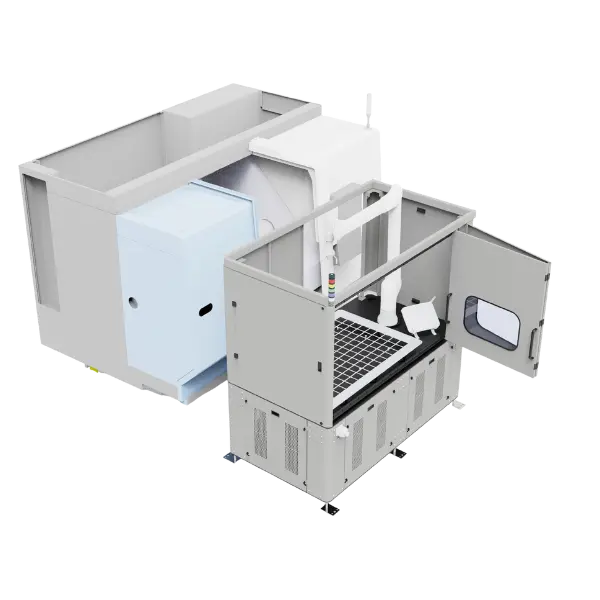
Most cobot automation content is written for a European or American reader, and it leads with the same argument every time: labour is expensive, robots are cheaper. That argument doesn't land the same way in Pune, Coimbatore, or Peenya. An Indian manufacturer reading it reasonably concludes the maths doesn't apply here.
But the manufacturers we talk to across India aren't automating to cut wage bills. They're automating because an export customer tightened a tolerance spec, because the third shift is impossible to staff consistently, because scrap rates climb after hour six of a manual shift, or because they've won a contract that needs 2x the output from the same floor space.
Those are different problems from the European ones, and they point to a different starting project. Here's a practical look at where cobot automation actually earns its place on an Indian production floor.
The question isn't whether a robot is cheaper than an operator. It's whether your spindle is running when nobody's standing next to it.
The Business Case That Actually Applies Here
Four pressures come up repeatedly in conversations with Indian manufacturers, and none of them are primarily about wages.
• Export Quality Consistency
Supplying European, Japanese, or American customers means holding dimensional tolerances audit after audit. A robot places a part the same way at 2 AM as it does at 9 AM. That repeatability is often what wins or protects the contract, not the labour saving attached to it.
• The Third Shift Problem
Night shifts are the hardest to staff reliably and the ones where quality slips most. A cobot cell with enough part capacity to run unattended turns the night shift from a staffing headache into additional machine hours.
• Turnover in Repetitive Roles
Machine loading and box stacking are among the highest-turnover positions on any floor. Every departure carries recruitment and retraining cost, and a learning curve during which quality dips. Automating the task removes that cycle entirely.
• Capacity Without Capex on Floor Space
Winning a bigger contract usually means finding more output, not more square footage. Raising utilisation on machines you already own is almost always cheaper than expanding the plant.
Start With CNC Machine Tending — Almost Always
If you're automating one thing first, it should usually be CNC machine tending. The task is repetitive, the part geometry is consistent within a family, and — critically — the return is easy to measure. Spindle uptime before, spindle uptime after. No arguments in the review meeting about whether the project worked.
A tray-based feeder cell like the ProFeeder loads blanks, waits out the machining cycle, unloads, and repeats — with enough tray capacity to keep going through a full unattended shift. For job shops running several related part numbers on rotating schedules, which describes most Indian contract manufacturers, changeover between part families is a matter of repositioning fixtures and loading a different program.
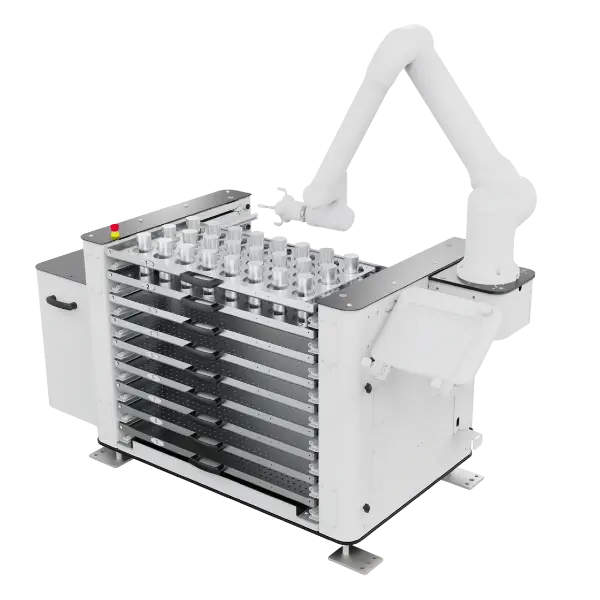
Tray capacity is what turns a tended machine into an unattended one
The Objection We Hear Most: "We Don't Have a Robotics Team"
This is the single most common reason automation projects stall, and it's a fair concern — hiring a dedicated robotics engineer is a real cost, and finding one is its own problem. It's also the assumption that pre-engineered cobot cells exist to remove.
The distinction is between buying a robot arm and buying a cell. A bare arm on a custom pedestal genuinely does need someone who can integrate it. A pre-engineered cell arrives with the mounting, the feeder, the fixturing, and the control integration already worked out — which is why EasyRobotics installations typically go from delivery to running production in 24 to 48 hours rather than the weeks a traditional integration project takes.
Programming new parts is designed to sit with your existing production staff, not a specialist. That matters more here than the installation speed itself: it determines whether the cell keeps getting used after the first job finishes, or quietly goes idle because nobody on the floor is confident reprogramming it.
💡 Quick Facts
• EasyRobotics is a Danish cobot automation company with 12+ years of experience, now expanding in India from Bangalore, Karnataka
• Pre-engineered cells install and run in 24–48 hours — no floor modifications required
• No in-house robotics team or dedicated IT infrastructure needed
• Cells are brand-agnostic across Universal Robots, Doosan, FANUC CRX, ABB, and KUKA
What Comes After the First Cell
Most manufacturers don't plan a full automation roadmap upfront, and they shouldn't. The first cell proves the business case internally and, just as importantly, builds confidence on the floor. What follows tends to depend on what the operation actually does.
Packaging and dispatch lines: EasyPalletizer handles end-of-line stacking — usually the last manual lifting task left once tending is automated, and one of the higher injury-risk jobs on the floor.
Fabrication shops: The EasyWeld Station brings consistent weld quality to bracket and subframe work. Note that welding cells need physical guarding regardless of the cobot's force limiting — we cover that in the cobot safety enclosure guide.
Multi-machine shops: If you have several machines that each need tending for only part of a shift, a mobile cobot workstation lets one robot serve all of them rather than buying a cell per machine.
✅ Your Floor Is a Strong Candidate If…
• You supply export customers with tightening tolerance or audit requirements
• Your third shift is hard to staff, or quality drops measurably on it
• You've won capacity you can't meet without more machines or floor space
• Machine loading or box stacking has high turnover in your plant
• You run repeating part families rather than one-off custom jobs
If your production is genuinely one-off and highly variable, or your parts need real-time human judgement mid-cycle, a customised automation solution is the better conversation — EasyRobotics engineers will assess the fit at no charge rather than pushing a standard cell that won't suit.
Running the Numbers for Your Own Floor
Published ROI figures are usually modelled on European labour costs and shift structures, so treat them as a shape rather than a number you can apply directly. What transfers cleanly is the method: measure your current machine utilisation honestly, model what it becomes with unattended running, and price the output difference against your own contract values.
The EasyRobotics ROI Calculator lets you input your own shift structure, part mix, and cost base rather than accepting a European default — which is the only way the payback figure means anything for an Indian operation.
Frequently Asked Questions
Conclusion
The standard automation pitch — robots are cheaper than people — was never the right argument for Indian manufacturing, and dismissing cobots on those grounds means missing the arguments that do apply: consistency for export contracts, machine hours nobody has to staff, and capacity without new floor space.
Start with the machine that sits idle most often, measure the uptime honestly before and after, and let that first cell make the case for the next one.
Automating a Production Floor in India?
Talk to an EasyRobotics specialist about your machines, shifts, and part mix.
Get a fit assessment and payback estimate for your plant — at no charge.