Do You Need One Cobot Per Machine?
Probably Not
How a mobile robotic workstation lets a single collaborative robot
serve several machines instead of sitting bolted to one.

Most cobot buying decisions start from the same assumption: one robot, one machine, bolted in place. It's a reasonable default for a single high-volume line. But a lot of small and mid-sized shops don't run one line — they run three or four machines that each need tending for part of a shift, not all of it. Buying a dedicated cobot and workstation for each one means paying for idle robot time on every machine that isn't currently running.
The alternative isn't a bigger, more expensive robot. It's a mobile robotic workstation — a cobot platform built to be relocated between machines rather than fixed to one, so the robot follows the work instead of waiting for it.
This isn't a theoretical idea. EasyRobotics' ProFeeder Mover is a mobile cobot stand built specifically for this use case, with more than 500 units already deployed across metal machining, automotive, pharma, electronics, and general assembly operations.
A fixed cobot is only working when its one machine needs it. A mobile one is working whenever any machine on its route does.
The Problem With One Cobot Per Machine
A dedicated cobot cell makes sense when a single machine runs a high enough volume to keep the robot genuinely busy across a shift. Plenty of job shops don't look like that. Instead, they have a saw, a CNC machine, a measuring station, and a packing bench — each needing an operator (or a robot) intermittently rather than continuously.
Automating that scenario with fixed, one-per-machine cobots means buying four robots to solve a problem that, on any given hour, might only need one. It's the same mismatch that makes hard automation a poor fit for high-mix production: the capital cost is sized for peak demand at every station simultaneously, when the real demand pattern moves between stations throughout the day.
How a Mobile Cobot Stand Actually Works
ProFeeder Mover pairs a robust cobot stand with an integrated mobile cart. Rather than anchoring the robot to a single spot on the floor, the platform docks against a machine, holds the robot rigidly in place for the duration of the tending cycle, then undocks and moves to the next station once that machine's cycle is done — carrying parts with it if needed.
Built from 7 mm steel, the platform (model PF-1000-M, H 932 × W 800 × L 1165 mm, 205 kg) is engineered to support full loading while in motion, with a top fixture plate that accepts different part shapes and 0° or 45° robot mounting options depending on how the cell needs to approach each station. It's designed to dock from all three sides, so the same unit can serve machines arranged in different layouts around the shop floor rather than requiring every station to face the same direction.
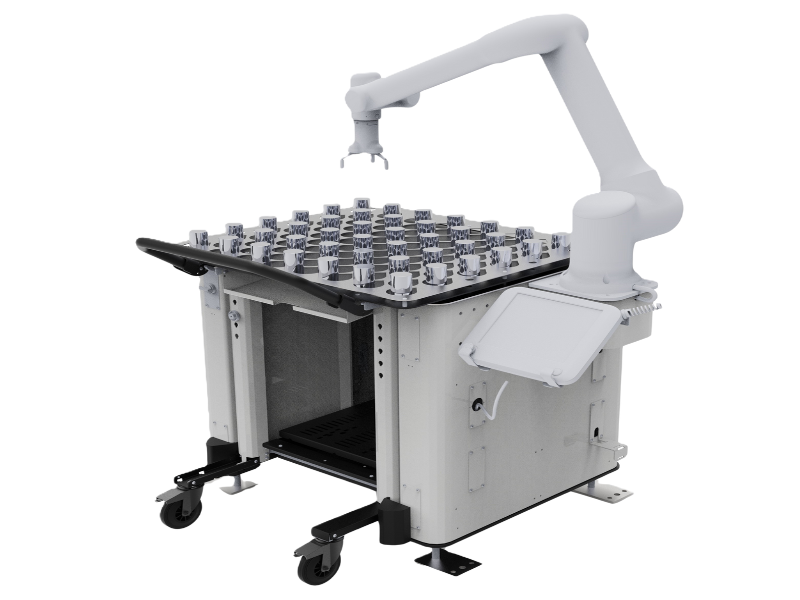
The mobile cart docks rigidly at each station, then relocates once the cycle is complete
What Changes When One Cobot Covers Several Stations
The most immediate change is in the manual handling that used to happen between stations. Moving parts from a saw to a CNC machine, then to a measuring station, then to packing is exactly the kind of repetitive transport task that eats operator hours without adding value to the part itself. EasyRobotics reports that automating this handoff with a mobile cell has taken operations that previously needed up to eight hours of manual handling per cycle down to under one.
The second change is capital efficiency. Instead of sizing automation spend to the busiest single station, a shop can size it to the total workload across all the stations the mobile cell will cover — because the robot isn't idle at three machines while working at the fourth.
The third is what happens when the schedule changes, which in a job shop is often. A fixed cell tied to one machine has no answer when that machine's job runs out early. A mobile cell simply docks somewhere else.
💡 Quick Facts
• ProFeeder Mover (PF-1000-M) is built from 7 mm steel with a 205 kg platform weight
• Docks from all three sides and supports full loading while in motion
• 0° or 45° robot mounting for flexible station approach angles
• Compatible with Universal Robots, Kassow Robots, and FANUC, subject to robot-specific validation
Where Mobility Fits — and Where a Fixed Cell Still Wins
Mobility is a trade-off, not a universal upgrade. A single machine running at genuinely high volume, where the robot is busy nearly every cycle, doesn't need to share itself with anything else — a fixed cell like ProFeeder Tray or ProFeeder S is the simpler, more direct answer there. Mobility earns its keep specifically when demand is spread across several stations that don't all need attention at once.
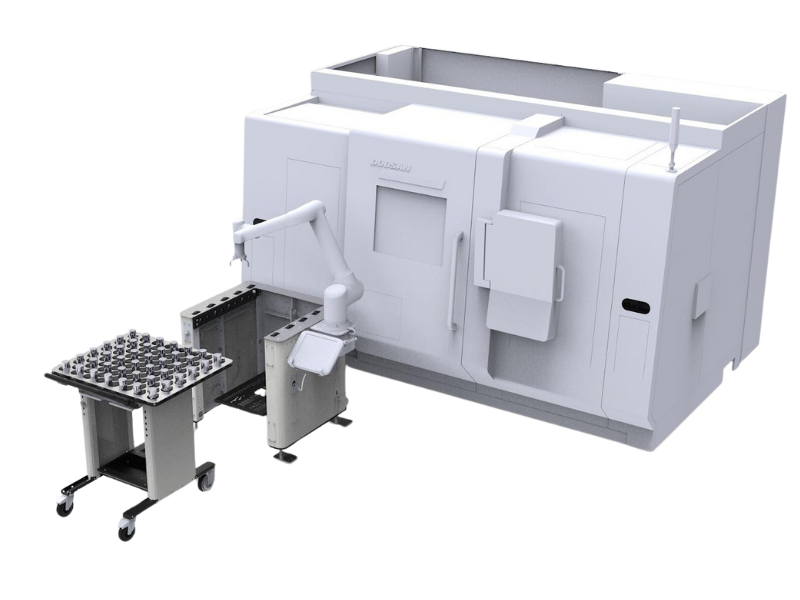
One mobile cell following the workload across saw, CNC, measuring, and packing stations
✅ A Mobile Robotic Workstation Fits Well If You Have…
• Several machines or stations, none of which needs tending 100% of the shift
• A workflow where parts move between stages — saw, CNC, measuring, packing
• A schedule that shifts often enough that a fixed cell would sit idle regularly
• A shop floor layout where machines face different directions or aren't in a straight line
• A goal of covering more machines without buying a robot for each one
If your production is closer to a single high-volume line running continuously, a fixed CNC tending cell will typically outperform a mobile one on that machine alone — EasyRobotics application engineers can help work out which model fits your layout, at no charge.
Where This Fits in a Broader Automation Plan
ProFeeder Mover isn't a standalone category — it shares the same modular design and cobot compatibility as the rest of the EasyRobotics range, so it works alongside fixed tending cells rather than instead of them. A shop might run a fixed ProFeeder S on its highest-volume machine and a Mover covering three lower-volume stations around it, with both sharing the same robot brand and control approach.
As a production layout evolves — new machines added, a line reorganised, a customer program that shifts volume between part numbers — a mobile cell adapts to that change without needing to be re-engineered or replaced, which a floor-anchored cell can't do.
Frequently Asked Questions
Conclusion
One cobot per machine is the default assumption, but it's not the only model — and for shops running several machines that each need tending for only part of a shift, it's often the more expensive one. A mobile robotic workstation flips the math: instead of paying for a robot at every station, you pay for a robot that follows the work.
Whether that trade-off makes sense depends entirely on your layout and schedule — which is exactly the kind of thing worth working through before committing to either approach.
Fixed Cell or Mobile? Let's Work Out Which Fits
Talk to an EasyRobotics application engineer about your machine layout and schedule.
Get a recommendation and an ROI estimate — at no charge.