Which Feeder Should Your Robot Use?
Bowl, Flex, Gravity or Tray
Most feeder guides are written for small-part assembly. Feeding a CNC machine
is a different job, and it usually points to a different answer.
Search for a robot feeder and you'll find a lot of material about vibratory bowls and vision-guided flex feeders. That makes sense, because most of that content comes from electronics and small-part assembly, where a robot has to grab thousands of tiny screws, clips or connectors that arrive in a heap.
A CNC shop has almost the opposite problem. The parts are bigger, heavier and fewer. A blank or a forging doesn't arrive in a heap, and nobody wants a robot fishing around for it. What the robot needs is to know exactly where the next part is, every time, for as long as possible without a person nearby.
So before choosing a feeder, it helps to know what each type is actually good at. Here are the five you'll come across, and the single question that usually decides between them.
The right feeder depends less on the robot than on one thing: does the part arrive loose, or can it be placed in a known position?
The Five Feeder Types, Briefly
• Vibratory bowl feeders
A bowl shakes small parts along a track until they line up in the right orientation, then hands them to the robot one at a time. Fast and cheap per part once it's running. The catch is that the track is shaped around one part, so changing to a different part usually means different tooling. They also struggle with large, heavy or easily damaged parts.
• Flex feeders
A flat platform vibrates loose parts around while a camera finds their position and orientation, and the robot picks whichever ones are lying the right way. More forgiving of part changes than a bowl, since much of the "tooling" is software. Still aimed at small parts, and the vision system adds cost and setup.
• Gravity feeders and chutes
Parts slide down an incline or sit in a stacked magazine and drop into a pick position. Very simple, with almost nothing to break. The limitation is geometry: it only works for parts that slide, stack or roll predictably.
• Conveyor feeding
A belt brings parts continuously to the robot. Good when parts are already flowing from an upstream process. If they land in random orientations you'll need vision and tracking to pick them.
• Tray or drawer feeders
Parts are placed in known positions in trays, and the robot picks from those fixed coordinates, so no vision is needed to find them. Trays slide out like drawers, so an operator can reload one while the robot works from another. This is the approach used for medium to heavy machined parts, blanks and forgings.
Why CNC Tending Usually Lands on Trays
Consider what a CNC tending job asks for. The parts are often heavy enough that a bowl is out of the question. They're usually machined to a known shape, so they can be laid out consistently. Batches are modest, and the same shop runs several part families in a week. And the whole point is to keep the spindle turning while nobody's standing there.
A tray feeder fits that. Because parts sit in known positions, the robot doesn't need a camera to find them, which removes a whole layer of setup and a common source of nuisance stops. The feeder holds a large batch, so the cell runs on its own for as long as the trays last. And changing part family mostly means loading different trays and calling up a different program.
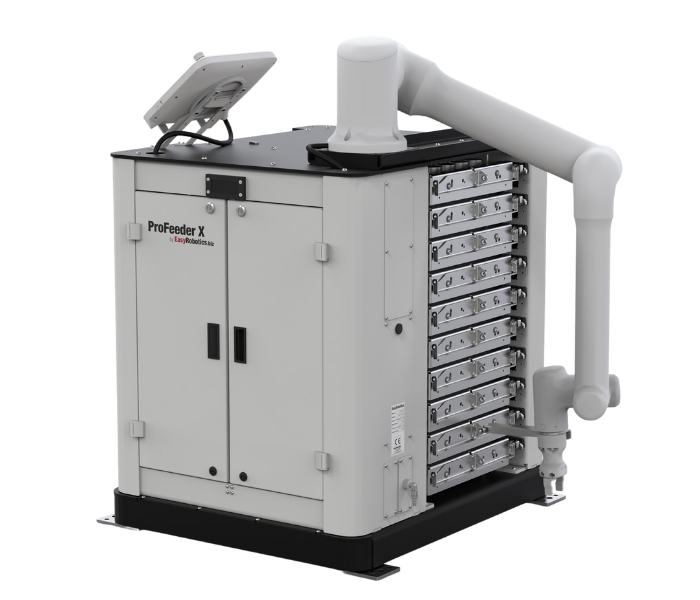
The ProFeeder X is a good example of the design. It's a drawer-style feeder with 2, 5 or 10 trays, rated up to 120 kg per tray, and it offers two locking options: AirLock, which is controlled through digital I/O using compressed air, and MechLock, which is a manual mechanical lock that needs no compressor. It mounts the cobot at four possible angles and sits in a footprint of roughly 980 × 920 mm.
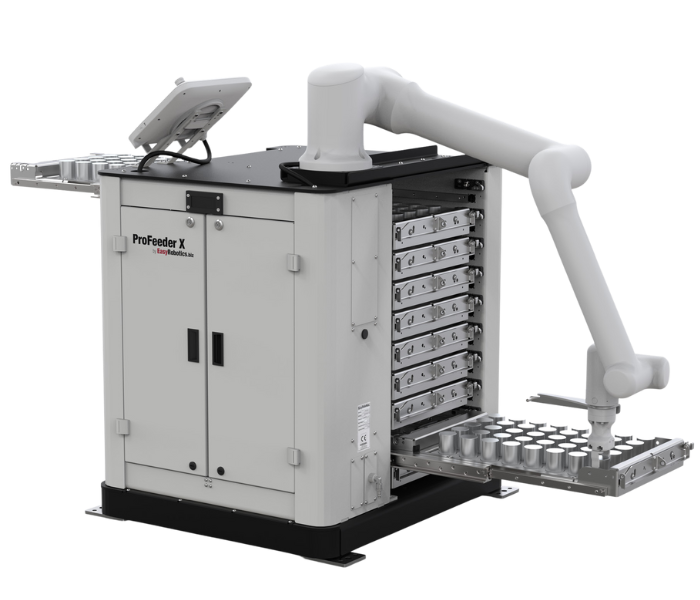
Drawer trays let an operator reload one while the robot keeps working from another
How Long Will It Run Without You?
"Lights-out" gets used loosely, so here's a way to check it against your own job. Unattended time is roughly the number of parts a full set of trays holds, multiplied by your machine cycle time.
As an illustration only, not a specification: if the trays hold 240 parts and each part takes 3 minutes in the machine, that's 720 minutes, or 12 hours. Halve the cycle time and you halve the run time. Double the parts per tray and you double it.
There's a trade-off hiding in that arithmetic. On the ProFeeder X order table, more trays means less height available per tray. The maximum part height falls from 240 mm on the 3-tray version to 80 mm on the 10-tray version. So a tall part can't take full advantage of a high tray count, and it's worth checking your part height before assuming the biggest configuration is the best one.
💡 Quick Facts
• Tray feeders hold parts in known positions, so no vision system is needed to find them
• Unattended time ≈ parts per full load × machine cycle time
• On ProFeeder X, max part height drops as tray count rises: 240 mm (3 trays) to 80 mm (10 trays)
• The cell also needs the machine door to open on its own; see the EasyDoor guide for that piece
When a Tray Feeder Is the Wrong Choice
It would be easy to say tray feeders suit everything, and they don't. A tray feeder assumes someone or something has already put the parts in position. If your parts arrive loose in a bin and they're small, you'd be paying an operator to arrange them by hand, and a bowl or flex feeder will do that job better.
The same goes for very high-volume, single-part production, where a dedicated bowl running one small part flat out is hard to beat on cost per part. Tray feeding earns its place where parts are heavier, batches are moderate, and several part families share the cell.
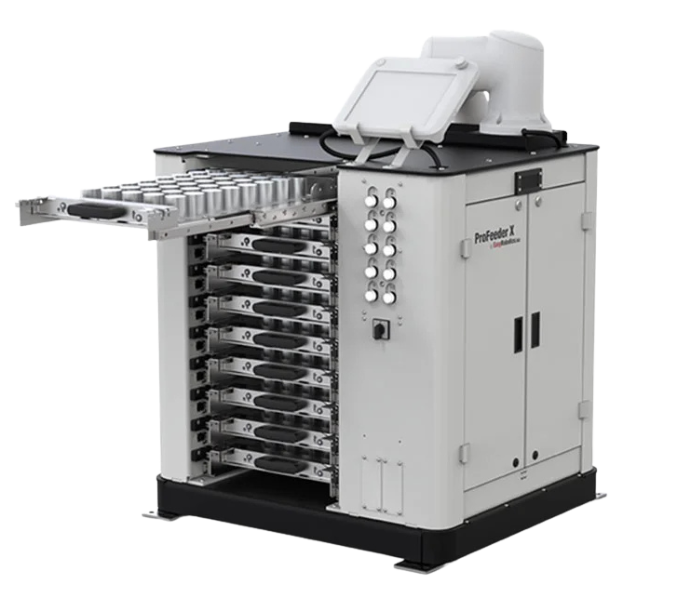
Compact enough to sit beside the machine it feeds
✅ A Quick Way to Pick
• Small parts arriving loose, one part number, high volume: vibratory bowl
• Small parts arriving loose, several part numbers: flex feeder with vision
• Parts that slide or stack predictably: gravity feeder or magazine
• Parts already flowing from an upstream process: conveyor
• Medium to heavy machined parts, blanks or forgings for a CNC machine: tray or drawer feeder
A Note on Names, Because It Causes Confusion
"Flex" means two different things in this field. In the feeder trade, a flex feeder is the vibration-and-vision device described above. ProFeeder Flex is something else: a mobile cobot stand, available as FlexBase, FlexOne and FlexThree, built for moving a robot between machines. If you need to feed loose small parts, ProFeeder Flex isn't that product.
If you're weighing the tray-based models against each other, the ProFeeder models comparison guide goes through them, and What Is ProFeeder? covers the range as a whole. If your part doesn't fit any standard configuration, EasyRobotics can look at a customised solution around it, at no charge.
For the wider picture of tending a CNC machine with a cobot, start with the CNC machine tending automation page.
Frequently Asked Questions
Conclusion
There's no single best robot feeder, only the one that suits the part. Small loose parts point to bowls and flex feeders. Heavier machined parts that can be placed in position point to trays, which is why tray feeding is so common in CNC tending.
Work out how your part arrives, how much of it you need loaded at once, and how long you want the cell to run alone. Those three answers will narrow the choice faster than any spec sheet.
Not Sure Which Feeder Fits Your Part?
Tell an EasyRobotics specialist your part, batch size and CNC machine.
We'll say honestly whether a tray feeder is the right fit — at no charge.