ProFeeder Comparison Guide:
Choose the Right Robot Cell
Compare part feeding, mobility and capacity before automating CNC machine tending.
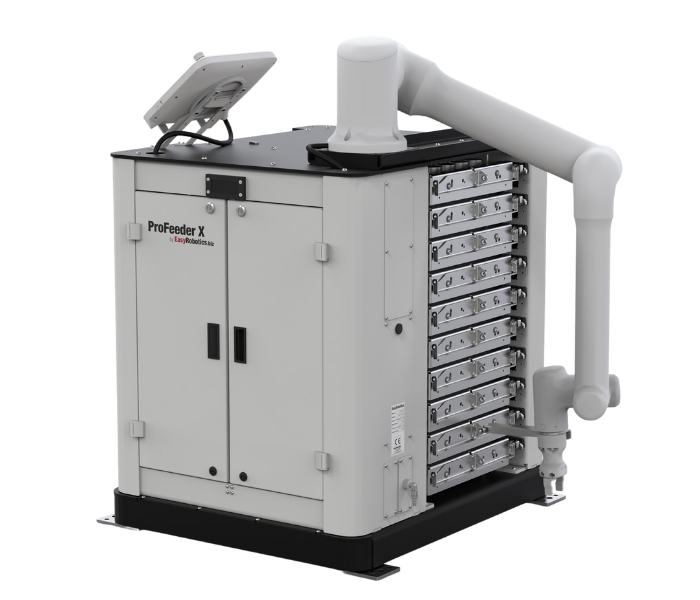
ProFeeder is not one machine. It is a family of robot work cells, mobile platforms and tray-feeding systems built for different production realities. A workshop loading small batches manually needs a different solution from a CNC line that must run for hours with minimal operator attention.
This comparison focuses on the decision manufacturers actually face: how parts will be presented, how much buffer capacity is required, whether the robot must move and how much future variation the cell must absorb.
Choose the feeding concept before optimising the robot. Reliable part presentation is what turns a cobot into a productive machine-tending cell.
ProFeeder Models at a Glance
| Model | Core idea | Best-fit discussion |
|---|---|---|
| Tray | Universal quick-change tray feeding | Repeatable parts and fast product changeovers |
| ALU | Compact aluminium-top robot workstation | Manual part changes, small series, assembly or finishing |
| Mover | Mobile platform serving work locations | Parts movement between CNC machines or stations |
| Flex | Mobile base with zero, one or three tables | Frequent relocation and changing workflows |
| S | Compact high-load tray system | Up to nine trays and heavy tray loads |
| Compact | Space-saving configurable tray cell | Up to ten trays where floor space is limited |
| X | Scalable 2, 5 or 10-tray platform | Growing from smaller batches toward unattended production |
| X-XL | Wider, higher-capacity X platform | Larger parts, up to 90 kg per tray and parts up to 320 mm tall |
For Simple Part Presentation: Tray or ALU
ProFeeder Tray uses a universal tray concept with quick changes between parts. It suits repeatable machine tending, assembly and handling where a clear tray layout is the practical feeding method. ProFeeder ALU is closer to a compact robot workstation: its aluminium-profile top supports manually changed parts and fixtures for small-series production, pick-and-place, finishing or assembly.
For Mobility: Mover or Flex
ProFeeder Mover is intended for transporting parts between machines, work cells and assembly locations. ProFeeder Flex is a manoeuvrable mobile cobot stand offered as FlexBase, FlexOne and FlexThree. The choice depends on whether the job is primarily moving material or creating a relocatable robot station with configurable work surfaces.
Tray capacity should be translated into minutes of unattended machining, not treated as an isolated number.
For Greater Buffer Capacity: S, Compact, X or X-XL
ProFeeder S combines a compact cell with up to nine trays, each rated up to 150 kg. ProFeeder Compact offers up to ten configurable trays in a space-saving cell and supports mechanical or air-lock options. ProFeeder X scales through 2, 5 or 10 trays with MechLock or AirLock choices. ProFeeder X-XL extends that concept with a frame 500 mm wider, capacity up to 90 kg per tray and parts up to 320 mm tall.
The largest tray count is not automatically best. Divide usable parts per loading by CNC cycle time. That gives the unattended window and reveals whether extra trays will create productive machine hours or simply occupy space.
A Five-Step Selection Method
1. Map every part: dimensions, weight, raw and finished condition, gripping surface and orientation.
2. Calculate the buffer: target unattended time divided by machine cycle time, allowing space for finished parts and rejects.
3. Check the layout: robot reach, CNC door, chuck or vice, aisle access and service clearance.
4. Decide mobility: compare one cell per machine with a platform redeployed between suitable jobs.
5. Validate the system: robot, gripper, interface, safety, tray locks, programming and acceptance test.
Information that produces a better recommendation
Provide part drawings or samples, CNC make and model, manual-cycle video, cycle time, batch quantities, desired unattended hours and a scaled layout. The result should be a complete cell concept, not a feeder selected in isolation.