ProFeeder Flex: The Complete Guide —
Specs, Models & Which Applications It Fits
The most maneuverable mobile robot cell in the EasyRobotics range.
Everything you need to evaluate, configure, and deploy it.

Most CNC machine tending cells are designed around a fixed assumption: the robot lives next to one machine, tends that machine, and stays there. That assumption works well for high-volume, single-part production. It works poorly for the job shop running twelve different part families on six machines, where what the floor actually needs is a robot cell that can be moved — quickly, repeatably, without reprogramming — from the lathe on Monday to the milling centre on Thursday to the deburring station on Friday afternoon.
The ProFeeder Flex is built for exactly that operating reality. It is the most maneuverable mobile cobot stand in the EasyRobotics range — heavy-duty wheels for agile movement in tight spaces, a floor docking system that locks the cell into a precise, repeatable position every time it returns to the same machine, and a universal cobot mount that accepts 99% of collaborative robot brands without modification.
This guide covers the complete ProFeeder Flex specification — all three models, their real dimensions and weights, the floor docking system that makes repeated repositioning viable in production, the seven application categories the system supports, and how it compares to the other ProFeeder variants so you can confirm it is the right choice for your specific operation.
"We run the ProFeeder Flex between three machines on a rotating schedule. The floor docking plates mean the robot knows exactly where it is every time — no re-teaching, no lost production time while we reposition. It changed how we think about what a job shop can do with one automation investment." — Bjarne T., Production Manager, EasyRobotics Customer
What Is the ProFeeder Flex — and What Problem Does It Solve?
The ProFeeder Flex is a mobile cobot stand and flexible robot cell manufactured by EasyRobotics. It is part of the ProFeeder family — the same product line that introduced compact, modular CNC machine tending to European manufacturing in 2015, with over 500 units now deployed across more than 30 countries.
What distinguishes the Flex from the rest of the ProFeeder range is the design priority. The ProFeeder S prioritises tray capacity for lights-out overnight production runs. The ProFeeder Compact prioritises the smallest possible footprint for space-constrained environments. The ProFeeder Mover prioritises powered mobility for cells that need to be moved frequently across large distances.
The ProFeeder Flex prioritises agility — the ability to move the cell quickly in tight spaces, dock it repeatably at the target machine, and switch the robot between completely different applications or machines without rebuilding the cell or re-teaching positions from scratch. It is the right choice when the production schedule is dynamic, when the same cobot investment needs to serve multiple workstations, or when the factory layout does not allow a permanent robot installation at every machine.
The problem it solves is not "how do I automate one machine" — there are simpler, cheaper cells for that. The problem it solves is "how do I get one automation investment to work across the whole shop floor, without permanently committing the robot to a single location."
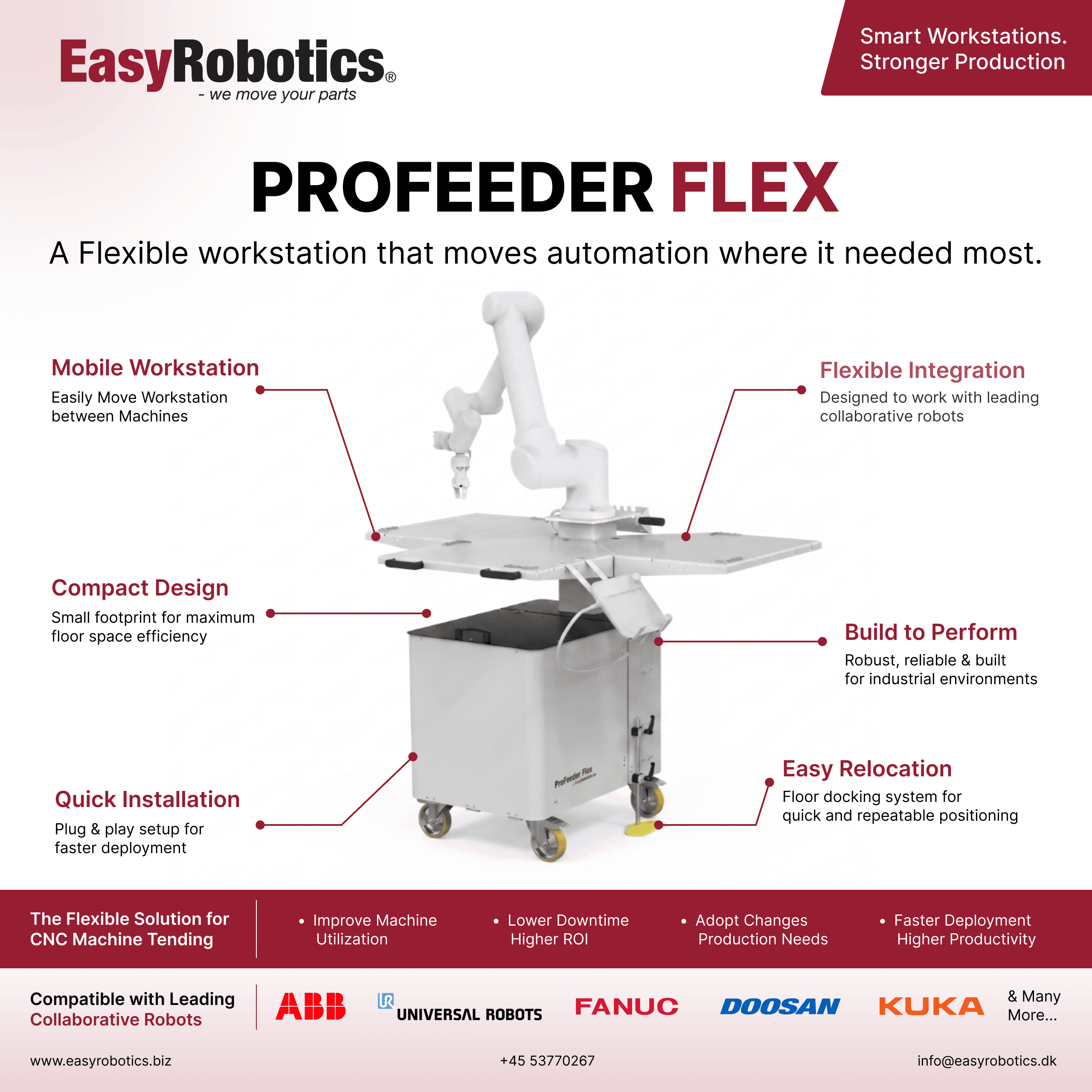
ProFeeder Flex — integrated cable management, flexible teach-pendant mount, and dedicated controller compartment in a compact 680mm wide platform
ProFeeder Flex: Three Models, Real Specifications
The ProFeeder Flex is available in three configurations — FlexBase, FlexOne, and FlexThree — each built on the same mobile cobot stand platform with the same floor docking system, controller compartment, and T-Pad universal mounting bracket. The difference between them is the number of side tables and the resulting footprint and weight.
FlexBase (PFF-1002-00) — Compact Mobility, Maximum Agility
FlexBase is the most compact ProFeeder Flex configuration — no side tables, which keeps the footprint at its minimum for the tightest production spaces. The controller compartment is integrated into the pedestal, keeping the robot controller protected and the cabling organised without adding external width to the cell.
📐 FlexBase Specifications — PFF-1002-00
Height: 1100 mm · Width: 680 mm · Length: 1000 mm
Weight: 100 kg
Includes: Floor docking system, T-Pad bracket, controller compartment, heavy-duty wheels
FlexBase suits job shops and contract manufacturers where the cell must fit into limited space alongside a CNC machine, and where parts staging is handled on a separate surface or directly from the machine fixture. At 680 mm wide, it is narrow enough to position between machines in most production floor layouts without requiring layout changes.
FlexOne (PFF-1002-01) — One Table, Balanced Configuration
FlexOne adds a single side table to the FlexBase platform. This is the most commonly selected ProFeeder Flex configuration — the table provides a dedicated staging surface for raw blanks or finished parts immediately adjacent to the robot, without significantly increasing the cell's footprint or weight.
📐 FlexOne Specifications — PFF-1002-01
Height: 1100 mm · Width: 680 mm · Length: 1000 mm
Weight: 115 kg
Includes: Floor docking, T-Pad bracket, controller compartment, one side table, heavy-duty wheels
FlexThree (PFF-1002-03) — Full Workstation, Maximum Staging Capacity
FlexThree adds three side tables, expanding the footprint significantly to create a complete, self-contained workstation with full staging capacity on all sides of the robot. This configuration is appropriate for assembly, finishing, and deburring applications where multiple part bins, tools, or outgoing staging areas must be immediately accessible to both the robot and the operator.
📐 FlexThree Specifications — PFF-1002-03
Height: 1110 mm · Width: 1522 mm · Length: 1096 mm
Weight: 150 kg
Includes: Floor docking, T-Pad bracket, controller compartment, three side tables, heavy-duty wheels
The Floor Docking System: Why It Makes Repeated Repositioning Viable
The floor docking system is the feature that makes the ProFeeder Flex genuinely different from a wheeled cobot workstation. Without it, moving a robot cell between machines requires re-teaching every robot position from scratch — because the cell never lands in exactly the same place twice. In a job shop moving the cell between machines weekly, that re-teaching time quickly eliminates the efficiency gain from the mobility itself.
The ProFeeder Flex's floor docking plates are anchor points bolted to the factory floor at each machine location. When the cell is pushed to a machine and lowered onto the dock, it engages mechanically and locks the cell in a precisely repeatable position — the same position, within the tolerance of the robot's own repeatability, every time it returns to that dock. The robot programme built for machine A works every time the cell returns to machine A's dock, without modification.
Additional docking plate sets (PFF-1002-04) are available for operations that want to create multiple docking positions across the facility — one dock per machine, or per workstation. An extra front/rear dock (PFF-1002-05) accommodates larger robot models that require a wider mounting footprint than the standard configuration provides.
This system transforms mobile automation from a concept into an operationally practical reality. Moving the cell from machine to machine is a matter of undocking, repositioning on the heavy-duty wheels, and redocking — a process that takes minutes, not hours.
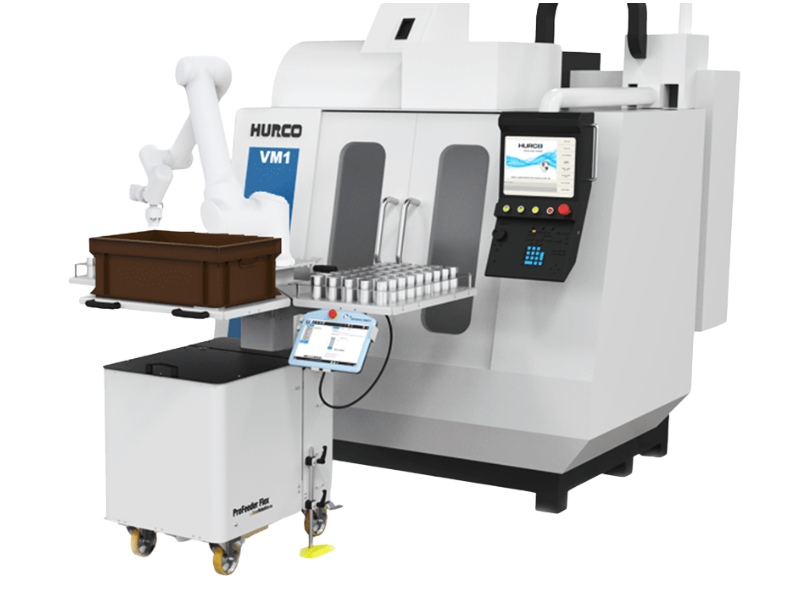
ProFeeder Flex in CNC machine tending application — docked at the machine with the cobot arm positioned for loading and unloading
Applications: What the ProFeeder Flex Can Automate
The ProFeeder Flex is one of the broadest-application cobot platforms in the EasyRobotics range — because its design is optimised around mobility and reconfigurability rather than around a single task. Seven application categories are directly supported.
• CNC Machine Tending
Loading raw blanks into a CNC lathe or milling centre and unloading finished parts is the most common ProFeeder Flex application. The floor docking system ensures the robot returns to the correct position at the machine every time, and the universal cobot mount accepts the UR, Doosan, or Kassow arm already in use. Combined with a EasyDoor automatic machine door opener, the ProFeeder Flex delivers fully unattended CNC loading without operator intervention between cycles.
• Deburring and Grinding
Post-machining deburring is one of the most ergonomically demanding and skill-dependent manual tasks in a metalworking shop. A cobot on a ProFeeder Flex cell can run a programmed deburring path consistently across every part, eliminating the variability in edge quality that manual deburring produces and removing the operator from close contact with cutting tools and metal debris. When the deburring run is complete, the cell moves to the next assignment.
• Finishing and Polishing
Surface finishing — polishing, buffing, brushing — requires controlled, repeatable force application along a defined path. A cobot with force control capabilities, mounted on the ProFeeder Flex, delivers consistent surface finish quality that manual operators cannot replicate across a full production batch, particularly at the end of a shift.
• Cutting
Trimming, plasma cutting, or waterjet cutting applications where the cobot guides the workpiece or the cutting head along a programmed path benefit from the ProFeeder Flex's stable, anchored platform — the floor docking system provides the rigidity needed for precision cutting paths even on a mobile cell.
• Welding
For light collaborative welding applications where the cobot handles the welding torch, the ProFeeder Flex provides a mobile platform that can be positioned at different weld stations without a fixed installation. For operations requiring a complete enclosed welding cell, the EasyWeld Station is more appropriate — but for job shops with occasional welding automation requirements alongside other applications, the Flex's flexibility is a significant advantage.
• Assembly
Component assembly tasks — press-fitting, fastener insertion, sub-assembly joining — benefit from the ProFeeder Flex's stable docked position and the FlexOne or FlexThree configuration's side table staging. The operator loads components on one side, the robot assembles, and finished sub-assemblies are staged on the other side.
🔧 ProFeeder Flex Application Quick Reference
• CNC Machine Tending — loading/unloading lathes and milling centres
• Deburring — consistent edge quality, operator away from cutting tools
• Grinding — repeatable material removal along programmed paths
• Finishing and Polishing — controlled force application for surface quality
• Cutting — precise path guidance for trimming and plasma cutting
• Welding — mobile collaborative welding for job shop environments
• Assembly — component insertion and sub-assembly with staged parts
ProFeeder Flex vs the Rest of the ProFeeder Range
The ProFeeder Flex sits in a specific position in the ProFeeder range — the right choice for high-mix, multi-machine operations that need to move the cell frequently. Understanding how it compares to adjacent models helps confirm whether it is the right ProFeeder for your specific situation.
📊 ProFeeder Range — Where Flex Fits
ProFeeder Tray / Alu: Fixed-position cobot workstation for stable, single-location CNC tending. No mobility. Best for dedicated single-machine automation. → ProFeeder Tray, ProFeeder Alu
ProFeeder S: Five-tray, 150kg/tray capacity for lights-out overnight production. Prioritises tray capacity over mobility. → ProFeeder S
ProFeeder Flex: Maximum maneuverability, floor docking for repeatable repositioning, 7 application categories. Best for job shops, high-mix, multi-machine environments. → ProFeeder Flex
ProFeeder Mover: Powered drive system for heavy cells across large facilities. Best when the distance between machines is large or floor surfaces make manual pushing impractical. → ProFeeder Mover
ProFeeder Compact / Compact XL / Compact Robot: Smallest footprint in the range, cobot mounts directly on top. Best for the most space-constrained single-machine CNC installations. → ProFeeder Compact
"The Flex was the answer to a question we had been asking for two years: how do we automate more than one machine without buying a robot for each one? The docking system was the piece that made it actually work in production — not just in a demo." — Anni P., Operations Director, EasyRobotics Customer
Cobot Compatibility and What to Specify Before You Order
The ProFeeder Flex's T-Pad universal mounting bracket is compatible with 99% of collaborative robot brands including Universal Robots (UR5e, UR10e, UR16e, UR20), Doosan, Hanwha, Kassow, FANUC CRX series, and AUBO Robotics. There is no factory modification required to switch between brands — the T-Pad interface accommodates them all.
For operations using larger robot models — UR20, Doosan H series, or other high-payload cobots with a wider base footprint — the extra front/rear dock (PFF-1002-05) is available to widen the docking footprint to match the larger robot base dimensions.
Before ordering, four things need to be confirmed with an EasyRobotics engineer: the robot model being mounted (to confirm T-Pad compatibility and whether the extra dock is required), the number of machines or workstations the cell will serve (to determine how many docking plate sets are needed), the application type (to confirm which FlexBase, FlexOne, or FlexThree configuration fits the workflow), and whether an automatic CNC machine door opener is required for fully unattended tending cycles.
ROI for a Multi-Machine ProFeeder Flex Deployment
The ROI calculation for a ProFeeder Flex deployment has a structural advantage over a single-machine cell: one investment serves multiple machines, spreading the fixed cost across a wider savings base. If one ProFeeder Flex serves two CNC lathes on staggered schedules — tending machine A in the morning, machine B in the afternoon — the labour saving is effectively doubled against the same system investment.
At a conservative all-in operator cost of €40/hour across a two-shift, two-machine deployment, the annual labour saving from one ProFeeder Flex cell can reach €160,000. Against a total system investment (ProFeeder Flex + cobot arm + docking plates) in the €45,000–€65,000 range, payback periods of 4–6 months are genuinely achievable — significantly faster than the 6–8 month typical for a single-machine dedicated cell.
Use the EasyRobotics ROI Calculator to model your specific shift structure, number of machines served, and labour cost — the multi-machine scenario inputs are directly supported.
Frequently Asked Questions
🔗 ProFeeder Range and Related Resources
• ProFeeder Flex — product page with 3D view, drawings, and quote request
• ProFeeder Tray — fixed-position CNC tending for dedicated single-machine use
• ProFeeder S — five-tray, high-capacity platform for lights-out overnight production
• ProFeeder Mover — powered drive for large-facility multi-machine operation
• EasyDoor — automatic CNC machine door opener for fully unattended tending cycles
• CNC Machine Automation Buyer's Guide — full evaluation framework for tending system selection
• ROI Calculator — model your multi-machine payback period
Conclusion
The ProFeeder Flex answers a question that most fixed-position automation systems cannot: how do you make one cobot investment serve the whole shop floor rather than a single machine? The floor docking system is what makes this question answerable in production — not just in theory. Docking plates at each machine mean the robot programme is valid every time the cell returns, without re-teaching, without lost production time, without the operational friction that makes multi-machine mobile automation impractical on most platforms.
Across three configurations — FlexBase for the tightest spaces, FlexOne for balanced workstation capability, FlexThree for full staging on all sides — and across seven application categories from CNC tending to deburring to collaborative welding, the ProFeeder Flex is the most operationally versatile mobile cobot platform in the EasyRobotics range. If your production schedule is dynamic, your machine mix is varied, and your automation budget needs to work harder than a single dedicated installation allows, it is very likely the right cell for your operation.
Ready to Configure Your ProFeeder Flex?
Tell an EasyRobotics engineer how many machines you want to serve, your robot brand,
and your most demanding application. Get a model recommendation within 24 hours — at no charge.