CNC Machine Automation: A Complete
Buyer's Guide for Manufacturers
System types, specifications, supplier questions, and the decision framework
for choosing the right CNC automation solution — before you request a quote.
The decision to automate CNC machine tending is usually straightforward. The financial case is clear, the technology is mature, and the pain of manual loading — idle spindles, operators stretched across too many machines, the night shift that runs at a fraction of day-shift output — is felt every day on the shop floor. The harder decision comes next: which CNC machine automation solution is actually right for your specific operation?
The market for robotic tending solutions has expanded considerably over the past five years. There are now genuine choices between system types, cobot brands, feeder configurations, and integration approaches — and the wrong choice in any one of these dimensions will create operational problems that no amount of post-installation adjustments can fully correct. A machine tending cell that is poorly specified for your part geometry will spend more time being reprogrammed than producing. A system on a fixed pedestal that should have been mobile will become an expensive obstacle when your production schedule shifts.
This guide provides a structured framework for making the right selection the first time. It covers the different types of CNC machine automation system, the specifications that actually matter and why, the questions to ask any supplier before you commit, and how the EasyRobotics ProFeeder range maps to the most common production environments.
"We spent three months evaluating systems before selecting EasyRobotics. The difference was that they asked more questions about our parts and our machines than they did about selling us a product. That gave us confidence the recommendation was right for our setup." — Lars M., Manufacturing Manager, EasyRobotics Customer
Step 1 — Define Your Production Profile Before Looking at Systems
The most common mistake in CNC automation procurement is approaching suppliers with the question "what can your system do?" before answering the prior question "what does my operation actually need?" The first question leads to a product pitch. The second question leads to a specification — and a specification is what you use to evaluate whether any given product is genuinely fit for purpose.
Your production profile for a CNC automation specification needs to capture six things clearly before any supplier conversation begins.
• Part range and geometry
What is the diameter, length, and weight range of the parts this cell needs to handle? Both raw blanks and finished parts — because the robot picks both, and if the finished part has a significantly different geometry from the blank, the gripper needs to accommodate both reliably. Identify the heaviest single part the robot must handle, as this drives the payload calculation.
• CNC machine type and door configuration
Is the machine a lathe, a milling centre, or a turning-milling centre? Does it have a sliding door, a vertical door, or a two-door configuration? What is the clearance between the machine door and the chuck or fixture when the door is fully open? These dimensions determine the robot's reach requirement and whether an automatic door opener is needed.
• Production mix and batch size
How many different part families does this machine run per week? What is a typical batch size? A cell that runs one part family at 5,000 units per batch needs very different changeover characteristics from a job shop cell that runs 15 different part families at 50–200 units each. High-mix operations need fast, simple changeover; high-volume operations benefit from higher automation of the changeover itself.
• Shift structure and unattended operation requirement
How many shifts does the machine currently run? Is there an ambition to run lights-out overnight? The shift structure determines the capacity requirement for the part feeder — a two-shift cell needs enough tray capacity to run through a shift without an operator reloading blanks, and an overnight lights-out operation needs even more capacity.
• Machine count and mobility requirement
Is this system for one dedicated machine, or will it need to serve multiple CNC machines on a rotating schedule? If the latter, mobility — lockable castors and quick repositioning — is a fundamental requirement, not a nice-to-have.
• Available floor space
What footprint is available alongside the CNC machine? In many job shops, floor space is tight and the cell must fit within a constrained envelope. Measure the available space before evaluating any system, and include the space needed for the tray loading access — not just the cell's static footprint.
Step 2 — Understand the System Types and Which Fits Your Profile
CNC machine automation systems fall into four broad architecture types. Understanding what each type is designed for — and where it falls short — prevents the most expensive specification errors.
Type 1: Mobile Feeder-Based Tending Cell
The most widely deployed architecture for job shops and contract manufacturers. A cobot arm is mounted on a mobile workstation that also carries a tray-based part feeder — typically with multiple trays stacked vertically. The robot picks blanks from the trays, loads the CNC machine, waits for the cycle, unloads the finished part, and returns it to a designated tray position. The whole cell rolls on lockable castors and can be repositioned to a different CNC machine in minutes.
This architecture suits high-mix operations that run multiple part families, need to serve more than one machine, or cannot commit the floor space to a permanent fixed installation. The EasyRobotics ProFeeder range — from the compact ProFeeder Compact through to the high-capacity ProFeeder X-XL — covers this architecture at every capacity level.
Type 2: Enclosed Tending Cell
A fixed cell with a physical safety enclosure around the robot work envelope. Required when the robot is operating at higher speeds than a collaborative robot's force-limited mode allows, or when a risk assessment determines that the proximity of operators to the robot motion requires physical separation. Enclosed cells have a larger footprint, are not easily relocated, and have higher integration costs due to the guarding, interlocks, and access systems involved.
For most SME CNC operations using collaborative robots, the enclosed cell architecture is not necessary. The EasyRobotics FlexiGuard Tending Station serves applications where an enclosed cell is genuinely required, with a pre-engineered design that avoids the cost and lead time of a bespoke custom integration.
Type 3: Fixed Pedestal with Separate Feeder
A robot arm on a fixed pedestal, with a separate parts conveyor, vibratory bowl, or indexing tray positioned nearby. Common in high-volume, single-part environments where the robot can be permanently optimised for one part family and the feeding system tuned specifically to that geometry. Less suitable for high-mix operations because changing the feeding arrangement for a new part is time-consuming and may require mechanical modification.
Type 4: Integrated Machine Tending with Automatic Door
Any of the above architectures with the addition of an automatic CNC machine door opener. This is not a separate system type so much as a common add-on that completes the automation cycle — replacing the door actuation step that a human operator would otherwise perform between every load and unload cycle. The EasyRobotics EasyDoor is a plug-and-play automatic door opener compatible with most CNC machine door configurations.
⚖️ System Type Quick Reference
Mobile feeder cell: High-mix, multi-machine, job shop environments. Best general-purpose choice. → ProFeeder range
Enclosed tending cell: Risk assessment requires physical guarding. Higher-speed robots. → FlexiGuard Tending Station
Fixed pedestal + feeder: High-volume, low-mix, single-machine dedicated applications. → EasyPedestal + application feeder
+ Automatic door opener: Any architecture, completes the unattended load/unload cycle. → EasyDoor
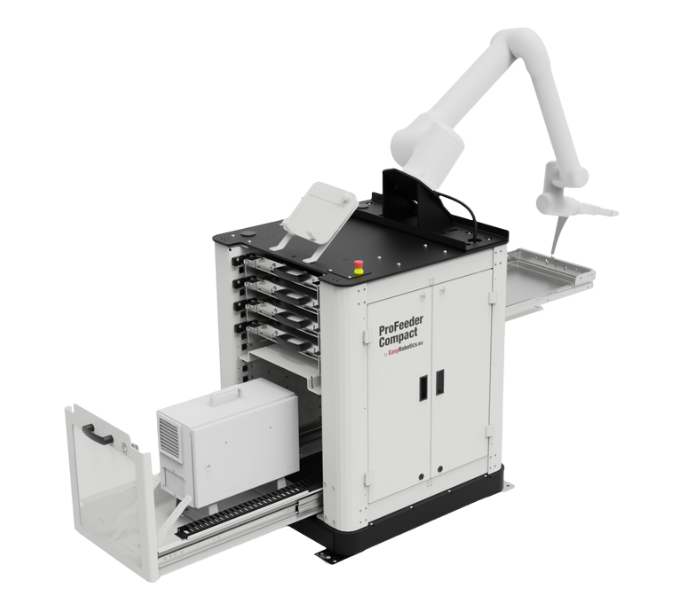
ProFeeder Compact Robot — pre-assembled CNC tending cell with integrated cobot, ready to run same day of delivery
Step 3 — The Specifications That Actually Determine System Fit
Once the system architecture is identified, four technical specifications determine whether a specific product within that category actually fits your application. These are the numbers to establish before any product comparison begins.
Robot Reach vs Machine Chuck Distance
The robot must be able to reach from the tray pick position to the machine chuck or fixture, passing through the open door, without exceeding 80–85% of its maximum reach. Operating at or near maximum reach reduces accuracy and puts mechanical stress on the joints over time. Measure the distance from where the cell will be positioned to the chuck face, and add the tray pick height, to establish the minimum reach requirement.
Payload: Gripper + Part Weight
Robot payload ratings are given as the maximum weight at the tool centre point — which includes the gripper itself, not just the part. A UR10e rated at 10 kg with a 2 kg gripper can handle parts up to 8 kg. Always specify payload as gripper-plus-part, and apply a 15–20% safety margin for acceleration forces at higher robot speeds. Exceeding the payload rating does not always cause immediate failure, but it degrades positioning accuracy and significantly shortens joint life.
Tray Capacity vs Shift Unattended Window
The number of parts the feeder system can hold determines how long the cell can run without an operator loading new blanks. Calculate the parts-per-hour rate at the planned robot speed, multiply by the target unattended window in hours, and this gives your minimum tray capacity requirement. For a lights-out overnight window of 8 hours at 30 parts/hour, the cell must hold at least 240 parts without requiring a reload.
Changeover Time vs Part Mix Frequency
For high-mix operations, changeover time — the time required to set up the cell for a new part family — is a specification, not an afterthought. A system that takes 4 hours to change over between parts is not suitable for a job shop that runs 10 different part families per week. Ask any supplier for a realistic, timed demonstration of changeover between two different part sizes, including tray reconfiguration, gripper swap if required, and programme selection.
Step 4 — Questions to Ask Every CNC Automation Supplier
The quality of the answers to these questions will tell you more about a supplier's suitability than any brochure. Suppliers who deflect, generalise, or provide vague commitments on these points are signalling that the specific requirements of your application have not been properly understood.
• "How will you confirm reach and payload for my specific machine and parts before we sign?"
A serious supplier will ask for your machine model, chuck height, and door opening dimensions, and will provide a reach confirmation — ideally a reach simulation or layout drawing — before order placement. Suppliers who say "it should be fine" without checking are not doing their job.
• "Can you show me a changeover on a system already deployed at a similar operation?"
A reference visit or video from a comparable application is the most reliable way to assess changeover time and the system's true suitability for high-mix production. EasyRobotics maintains customer references across industries and can facilitate these visits.
• "What does the installation and commissioning process actually involve on my end?"
The honest answer for an EasyRobotics ProFeeder deployment is: very little. Roll the cell into position, connect power, load parts, and select the programme. The answer that should raise a concern is one that involves floor modifications, integration engineers on site for multiple days, or a commissioning process that requires production to stop.
• "What happens when I need to add a new part that doesn't fit in the existing gripper?"
This question reveals the real-world flexibility of the system. A good answer describes the gripper change process, who does it, how long it takes, and what it costs. A bad answer reveals that the system is less flexible than the brochure implied.
• "What support is available after installation — and what does it cost?"
Remote access for diagnostics, response time commitments, and pricing for on-site visits are all worth establishing upfront. EasyRobotics provides remote support access as standard and on-site visit support within agreed SLAs.
The EasyRobotics ProFeeder Range: Which System Fits Which Application
The EasyRobotics ProFeeder range covers the full spectrum of CNC machine automation requirements from compact single-machine cells through to high-capacity overnight tending platforms. All models share a common design language — same cobot compatibility protocol, same software interface, same mobile base design — so experience on one system transfers directly to any other.
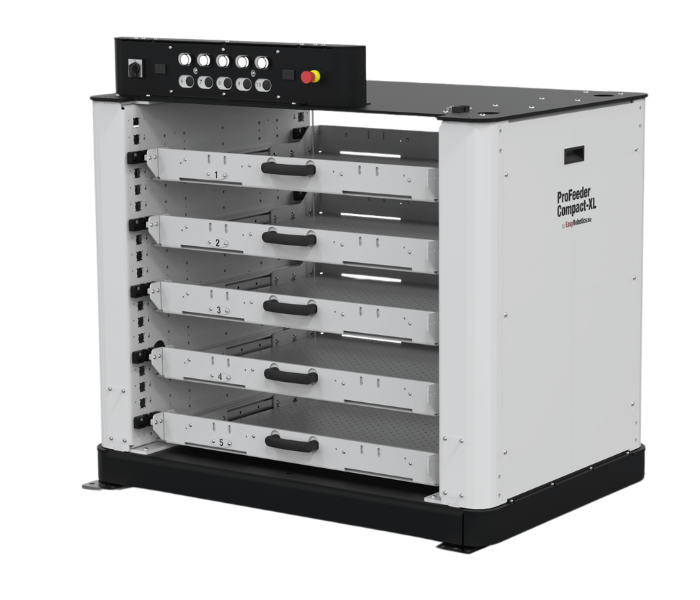
• ProFeeder Compact / Compact XL
The compact footprint models for CNC operations where floor space is the primary constraint. The Compact XL extends tray capacity for longer unattended windows without increasing the cell width. Both are fully compatible with UR, FANUC, Doosan, ABB, and KUKA cobots.
• ProFeeder S
Five-tray configuration with up to 150 kg capacity per tray — the highest-capacity standard EasyRobotics tending cell. Designed for operations targeting overnight lights-out production without requiring operator intervention for blank reloading during the unattended window.
• ProFeeder Tray / ProFeeder Alu
The versatile mid-range workhorses of the ProFeeder family. Tray or aluminium profile construction depending on fixturing preference. The Alu variant's profile system allows custom fixture mounting for non-standard part geometries.
• ProFeeder Mover
Enhanced mobility version with a powered drive system for easier repositioning in facilities where manual pushing is impractical due to cell weight or floor surface. Suited to operations that regularly move the cell between multiple CNC machines across the facility.
• ProFeeder X / ProFeeder X-XL
Extended reach and capacity for larger machining centres, bigger billets, or heavier finished parts. The X-XL is the highest-capacity mobile tending cell in the range, suited to turning centres machining large-diameter or long-length components.

ProFeeder Mover — powered mobility for operations where a single tending cell serves multiple CNC machines across the facility
Common Specification Mistakes — and How to Avoid Them
After supporting automation projects across hundreds of CNC machine environments in more than 30 countries, EasyRobotics engineers have observed the same specification errors appearing repeatedly. Awareness of these upfront costs less than discovering them after installation.
• Specifying for the average part instead of the most demanding part
System specifications must be based on the most demanding part in the range — the heaviest, the longest reach to place, the tightest geometry tolerance. If the system can handle the most demanding case, it will handle everything else. If it is specified for the average case, it will fail on the outliers.
• Ignoring the door opening and its effect on robot reach
The robot must reach through the open door to the chuck, and the door opening must be wide enough for the robot's end-of-arm tooling to pass through without collision. Many buyers specify reach to the machine face without accounting for the required path through the door opening, which can add 200–400 mm to the effective reach requirement.
• Underestimating changeover time requirements for high-mix operations
A system that looks attractive at the demonstrated changeover time for one pre-configured part can look very different when a genuinely new part family — different grip geometry, different tray layout — is introduced. Always assess changeover time on a cold change, not a warm repeat of an already-configured part.
• Choosing a fixed-position system for a production environment that will change
Production schedules, machine mixes, and customer demands all change over the life of an automation investment. A system on lockable castors that can be moved in minutes costs the same as one that cannot and offers significantly more long-term flexibility. Unless there is a specific operational reason to fix the cell permanently, specify mobility as a standard requirement.
Frequently Asked Questions
🔗 Explore the EasyRobotics CNC Tending Range
• CNC Machine Tending Solutions — full overview of EasyRobotics tending automation
• ProFeeder Tray — the most widely deployed CNC tending cell in the range
• ProFeeder S — high-capacity 5-tray cell, 150 kg per tray, for lights-out production
• ProFeeder X / X-XL — extended reach for larger machining centres and heavier billets
• EasyDoor — automatic CNC machine door opener for fully unattended tending cycles
• FlexiGuard Tending Station — enclosed cell where guarding is required
• Cobot Automation ROI Guide — calculate your payback period before committing
Conclusion
Selecting the right CNC machine automation system is not primarily a technology decision — it is a specification decision. The technology is mature and reliable across all the major platforms. What separates a successful automation project from a frustrating one is whether the system was specified correctly for the actual production environment: the right part range, the right payload, the right reach, the right feeder capacity for the planned shift structure, and the right degree of mobility for a production floor that will not stand still for the next five years.
Use the framework in this guide — production profile first, system type second, specifications third, supplier questions fourth — and the selection process becomes structured rather than speculative. The EasyRobotics team is available to work through this framework with you for your specific operation, provide reach and payload confirmation for your machine and parts, and recommend the ProFeeder configuration that fits your production profile — at no charge, and without obligation.
Ready to Specify the Right CNC Automation System?
Share your machine type, part range, and production profile with an EasyRobotics engineer.
Get a system recommendation, reach confirmation, and payback calculation — at no charge.