EasyPalletizer: The Complete Product Guide —
Specs, Configurations & Which Model to Choose
Real specifications, pedestal options, model comparisons, and industry applications
for the full EasyPalletizer range — before you request a quote.

When manufacturers search for an end-of-line palletizing solution, they typically find a category. Robotic palletizers. Cobot palletizers. Automated palletizing systems. What they need is a product — with real dimensions, real weight, real pedestal heights, real pallet format compatibility, and a clear answer to the question that actually matters: which configuration is right for my specific operation?
The EasyPalletizer range is not a single product. It is a family of four palletizing platforms — Basic, Standard, Pro, and Flex — each targeting a distinct set of production requirements. Understanding what each one actually is, what it includes, what specifications differ between them, and which industries and applications each serves is the prerequisite for making the right selection. This guide provides that information with real numbers from the actual product specifications.
If you already know which EasyPalletizer model you need, the product page and the ROI Calculator are your next steps. If you are still deciding, this guide will get you there.
"We deployed the EasyPalletizer Standard across three production lines in the first year. The dual pallet configuration was the feature that made the biggest operational difference — the robot never had to wait while we swapped pallets." — Thomas K., Packaging Manager, EasyRobotics Customer
What the EasyPalletizer Actually Is — Core Architecture and Features
The EasyPalletizer is a pre-engineered collaborative robot palletizer manufactured by EasyRobotics in Sønderborg, Denmark. It is not a robot arm — it is the complete mobile workstation on which the robot arm mounts, including the pallet positioning, sensing, and integration systems that allow the robot to palletize accurately and reliably without custom integration work.
The core design supports two pallets simultaneously — one being built while the other can be cleared and reloaded. This dual-pallet architecture eliminates the dead time between completed pallets that single-pallet systems create: when the robot finishes one pallet, it begins the next immediately while an operator removes the completed load from the idle station.
Four detection pins on each pallet side confirm that the pallet is correctly docked before the robot begins stacking — preventing the misaligned loads that cause product damage and downstream logistics issues. Ethernet RJ45 connectivity enables integration with MES, SCADA, or production monitoring platforms. Two multi-colour LED lamp blocks on the front face provide at-a-glance operational status visible from across the production floor. Push buttons above each lamp block handle side operations and can be configured as reset or pallet activation controls.
The base unit (PT-1010) weighs 195 kg without a robot or lifting column. All units are mobile on lockable castors, allowing repositioning between production lines. Stainless steel (AISI 304) construction is available across all standard configurations for food-grade, pharmaceutical, or washdown environments.
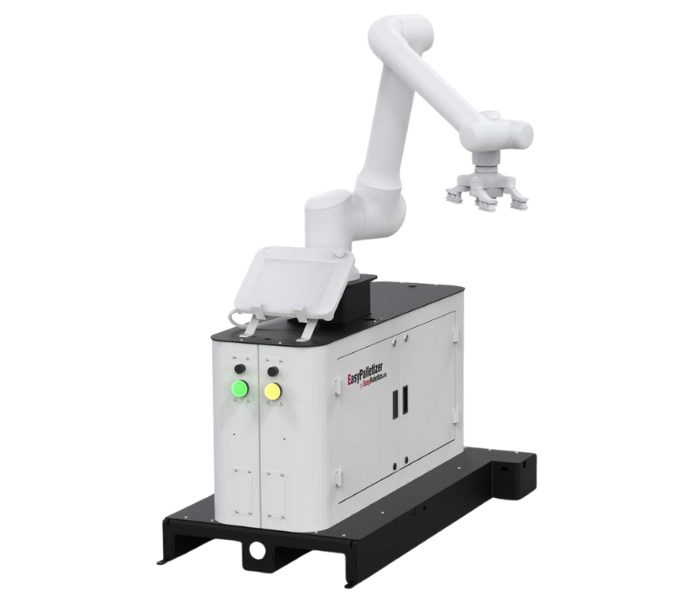
EasyPalletizer key functions: Ethernet RJ45 connector, push-button controls, 4-pin pallet detection per side, and dual multi-colour LED status lamps
EasyPalletizer Model Comparison: Basic vs Standard vs Pro vs Flex
The four EasyPalletizer models share the same core design intent — a mobile, pre-engineered cobot palletizer that deploys same-day without integration engineers — but each targets a different position on the capability and complexity spectrum.
EasyPalletizer Basic — Zero Electronics, Zero Programming
The Basic is a 100% mechanical palletizer platform. There are no electronics, no software, no sensors, and no control interfaces. The entire system is structural — a precisely engineered mechanical base that positions the pallet in exactly the right location for the robot to stack accurately, based on the robot's own programme. It is the right choice for simple, fixed-pattern palletizing applications where the robot programme handles all the intelligence and the platform just needs to hold the pallet accurately and stably. Deployment is entirely same-day, with no commissioning steps for the platform itself beyond positioning and connecting the robot arm.
The Basic suits entry-level automation for manufacturers who know their palletizing pattern is fixed, their pallet format is consistent, and their primary priority is the lowest possible total system cost. Explore it at: EasyPalletizer Basic.
EasyPalletizer (Standard) — The Core Platform, Most Widely Deployed
The Standard EasyPalletizer adds the full sensor and connectivity suite to the mechanical base: four pallet detection pins per side, dual LED status lamps, Ethernet RJ45 port, configurable push-button controls, and a Euro-pallet console with internal compartments for robot controller, cables, and ancillary equipment. This is the most widely deployed EasyPalletizer configuration across the 1,000+ installations in 30+ countries.
Available in three pedestal configurations: base unit only (PT-1010, H: 710mm, W: 870mm, L: 1350mm, 195 kg), fixed pedestal 835mm (PT-1011, 215 kg), and fixed pedestal 1200mm (PT-1013, 220 kg). All three are also available in AISI 304 stainless steel (PT-1010-SST, PT-1011-SST, PT-1013-SST). The adjustable pedestal option (876–1776mm height range) is available separately for operations where conveyor height varies or flexibility is required. Explore it at: EasyPalletizer.
EasyPalletizer Pro — High Payload, Multi-Format, Global Pallet Compatibility
The Pro is designed for operations requiring higher payload capacity — supporting cobots with payloads up to 20 kg per pick, including UR20 and Doosan H series — and for those needing to handle multiple international pallet formats. The Pro accommodates US (48" × 40"), European (1200 × 800mm and 1200 × 1000mm), and Australian standard pallet sizes within a single adjustable platform, making it the most globally versatile configuration in the range.
The Pro also supports both palletizing and depalletizing in a single system — a significant operational benefit for distribution centres and warehousing operations that need to both build and break down pallet loads. Extendable legs accommodate larger cobot footprints. Integrated robot controller storage keeps the installation tidy and the working footprint minimal. Explore it at: EasyPalletizer Pro.
EasyPalletizer Flex — Future-Proof, Width-Adjustable Base
The Flex is the newest and most adaptable platform in the EasyPalletizer range. Its patented width-adjustable base accommodates different robot brands and pallet sizes without mechanical modifications to the platform itself — making it the right choice for operations where the robot model, pallet format, or both may change over the system's service life.
The Flex ships 90% pre-assembled from the factory for the fastest possible commissioning. A movable pedestal allows full relocation between workstations in minutes. Lifting column heights up to 170cm accommodate tall pallet builds. Optional safety scanner integration and conveyor solutions are available. A stainless steel variant is available for food-grade and pharmaceutical environments. Explore it at: EasyPalletizer Flex.
📊 EasyPalletizer Model Comparison at a Glance
EasyPalletizer Basic: Mechanical only. No sensors, no electronics, no programming. Fixed-pattern, lowest entry cost. → View
EasyPalletizer Standard: Pallet detection, Ethernet, LED lamps, push buttons. Fixed pedestals 835mm/1200mm or adjustable 876–1776mm. Stainless steel available. Most deployed. → View
EasyPalletizer Pro: High payload (up to 20kg/pick). US, EU, and AU pallet formats. Palletizing + depalletizing. UR20 and Doosan H compatible. → View
EasyPalletizer Flex: Patented width-adjustable base. Any robot brand, any pallet format. 90% pre-assembled. Stainless steel. Safety scanner ready. → View
EasyPalletizer Specifications: The Numbers That Determine System Fit
Before selecting a model, four physical specifications need to be confirmed against your production environment. These are the numbers that most often determine whether a system works or requires modification after installation.
• Platform Dimensions
The standard EasyPalletizer footprint is 870mm wide × 1350mm long. This is the base unit dimension — it does not include the space needed alongside the platform for pallet loading access, which should be factored into the available floor space assessment. Width: 870mm accommodates standard Euro-pallet widths. For US 48" × 40" formats, the EasyPalletizer Pro's adjustable width accommodates this without platform modification.
• Pedestal Height vs Conveyor Height
The robot arm is mounted on the pedestal. The pedestal height must position the robot at the correct elevation to reach both the infeed position (conveyor or staging surface) and the maximum pallet stack height without exceeding 80–85% of the robot's reach. The Standard EasyPalletizer offers fixed heights of 835mm and 1200mm, plus an adjustable option spanning 876–1776mm. If your conveyor height is non-standard or variable, specify the adjustable pedestal (PTB-1004) from the outset.
• Robot Payload vs Product + Gripper Weight
The combined weight of the gripper (end-of-arm tool) and the heaviest product per pick determines the required robot payload. For most box, carton, and bag palletizing applications, Universal Robots UR10e (10kg) or UR16e (16kg) cover the requirement. For heavy bags, pails, or dense product formats, the EasyPalletizer Pro accommodating UR20 (20kg) or Doosan H (20kg+) is the appropriate configuration.
• Stainless Steel vs Carbon Steel
Standard carbon steel construction is suitable for dry industrial environments. AISI 304 stainless steel construction is required for food contact environments, pharmaceutical cleanrooms, regular washdown with cleaning chemicals, or any application where corrosion resistance must be maintained over the system's service life. All EasyPalletizer Standard configurations are available in stainless steel at equivalent specifications.
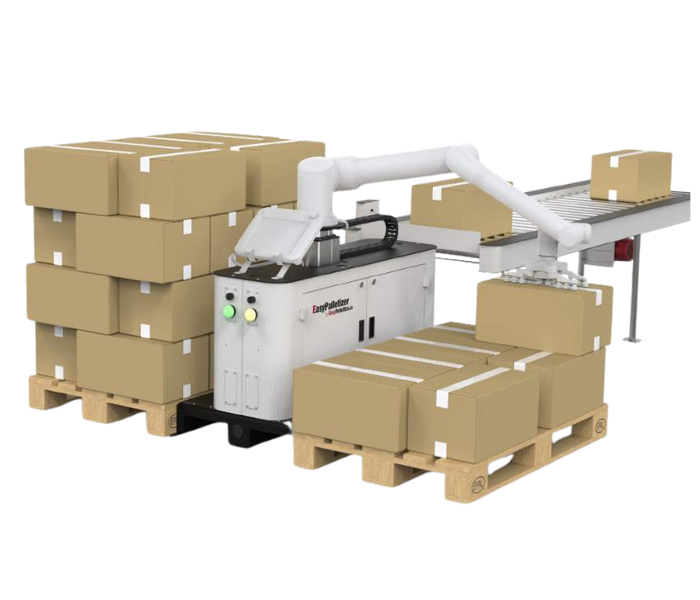
EasyPalletizer Standard — Euro-pallet console with internal controller compartment, mobile on lockable castors, 870mm × 1350mm base footprint
EasyPalletizer by Industry: Which Configuration for Which Application
The EasyPalletizer is deployed across five main industry sectors. While the core platform is the same, the configuration choices — model, pedestal height, construction material, and cobot selection — differ meaningfully between them.
• Food and Beverage
Food environments prioritise hygiene above most other considerations. The stainless steel AISI 304 construction variants (PT-1010-SST, PT-1011-SST, PT-1013-SST, or EasyPalletizer Flex stainless) are the appropriate specification wherever washdown or food-contact cleaning protocols apply. The EasyPalletizer Flex stainless with optional safety scanner integration suits continuous high-volume food lines where production cannot stop for pallet changes. The dual-pallet architecture — one station palletizing while the other is cleared — maintains throughput without gaps. Automated palletizing for food and beverage is also one of the strongest injury-avoidance applications: heavy case palletizing is among the highest-injury-frequency manual tasks in food manufacturing.
• Pharmaceuticals
Pharmaceutical environments combine the hygiene requirement of food applications with a higher emphasis on regulatory traceability and documentation. Stainless steel construction, Ethernet connectivity for integration with line monitoring and batch tracking systems, and consistent, auditable pallet patterns are the key requirements. The standard EasyPalletizer with its RJ45 port and configurable LED/push-button interface provides the integration points needed for pharmaceutical line MES connectivity.
• Electronics and Consumer Goods
Electronics palletizing typically involves lighter products at higher throughputs, with frequent SKU changeovers as product variants change. The standard EasyPalletizer with UR10e suits most electronics carton palletizing applications. The EasyPalletizer Flex is particularly appropriate where the product mix is expected to evolve — its adjustable base accommodates different pallet formats without mechanical modification when a new product family requires a different pallet size or stacking pattern.
• Metal and Industrial Manufacturing
Heavier industrial products — metal castings, machined components in trays, heavy-duty packaging — require the higher payload configurations. The EasyPalletizer Pro with UR20 or Doosan H series suits applications where product plus gripper weight approaches 15–20 kg per pick. The robust steel construction of the Pro platform handles the dynamic loads from higher-payload robots without the resonance or vibration that lighter platforms introduce at sustained cycle speeds.
• Warehousing and Distribution
Distribution centre applications often require depalletizing — breaking down inbound pallet loads — in addition to palletizing outbound shipments. The EasyPalletizer Pro is the correct choice for any application combining both palletizing and depalletizing, as it is the only model in the range purpose-designed to support both operations in a single system. US pallet format compatibility in the Pro also suits North American distribution operations without format adaptation.
"The stainless steel EasyPalletizer was the only palletizing system that met our food-grade washdown requirements without needing custom fabrication. It was on the production floor and running within two days of arrival." — Anna B., Line Manager, Food Manufacturer, EasyRobotics Customer
EasyPalletizer Cobot Compatibility: Which Robot for Which Application
The EasyPalletizer is a robot-agnostic platform — it does not include a robot arm as a default, and it is compatible with most collaborative robot brands deployed in European and global manufacturing. The robot selection is separate from the platform selection and is driven by payload, reach, and customer preference.
For the majority of box, carton, and lighter product palletizing, Universal Robots UR10e (10 kg payload, 1300mm reach) is the most widely deployed combination. For medium-weight products where pick weight approaches 12–14 kg including the gripper, UR16e (16 kg, 900mm reach) provides the additional payload margin. For the heaviest applications, UR20 (20 kg, 1750mm reach) or Doosan H series gives the payload capacity required and is specifically supported by the EasyPalletizer Pro's extended architecture.
FANUC CRX series cobots are also compatible where customers have an existing FANUC infrastructure or preference. Kassow cobots — with their 7-axis architecture — are well-suited to palletizing applications where the extra axis of freedom provides reach advantages around obstacles that a 6-axis robot cannot address without repositioning the platform. EasyRobotics engineers will confirm robot compatibility for your specific product, conveyor height, and maximum stack height before order — this confirmation is provided at no charge as part of the standard pre-sale consultation.
Decision Framework: Which EasyPalletizer Is Right for Your Operation?
✅ Choose EasyPalletizer Basic if:
• Your palletizing pattern is fixed and unlikely to change
• You want the lowest total system cost
• The robot programme handles all pattern intelligence
• Sensor feedback, Ethernet integration, and status displays are not required
✅ Choose EasyPalletizer Standard if:
• You need pallet detection, status lamps, and Ethernet connectivity
• Your product is boxes, bags, or cartons up to 12–14 kg per pick
• You are in a dry industrial, food-grade, or pharma environment (stainless option)
• Your pallet format is standard Euro or similar and consistent
✅ Choose EasyPalletizer Pro if:
• Product plus gripper weight approaches or exceeds 15 kg per pick
• You need US, EU, and Australian pallet format compatibility
• You need both palletizing and depalletizing from a single system
• You are deploying UR20, Doosan H, or other high-payload cobots
✅ Choose EasyPalletizer Flex if:
• Your robot brand or pallet format may change over the system's service life
• You want maximum future-proofing without platform replacement
• You need optional safety scanner integration
• You require food-grade stainless construction with full operational flexibility
Frequently Asked Questions
🔗 EasyPalletizer Range — All Models
• EasyPalletizer Basic — mechanical only, zero programming, lowest entry cost
• EasyPalletizer — standard configuration, most widely deployed, stainless steel available
• EasyPalletizer Pro — high payload, multi-format, palletizing + depalletizing
• EasyPalletizer Flex — width-adjustable, any robot, any pallet, future-proof
• EasyPallet Station — complete palletizing station including conveyor integration
• ROI Calculator — calculate your payback period for your specific operation
• Cobot Automation ROI Guide — full ROI formula and worked examples by application
Conclusion
The EasyPalletizer range covers end-of-line palletizing requirements from the simplest mechanical positioning platform through to a fully intelligent, stainless-steel, width-adjustable system capable of serving any cobot brand and any pallet format globally. The right model depends on four variables: the electronics and connectivity requirement, the product weight per pick, the pallet format, and the degree of flexibility needed for future production changes.
In most single-format, fixed-pattern applications, the Standard EasyPalletizer with the appropriate pedestal height and cobot model is the correct and most cost-efficient choice. Where heavy products, multiple pallet formats, or future-proofing requirements come into play, the Pro or Flex configurations address those requirements without requiring a custom-engineered solution. Every EasyPalletizer ships same-day deployable. Every model is compatible with 99% of cobot brands. And every configuration is supported by EasyRobotics engineers who will confirm the right specification for your specific application at no charge before you commit.
Ready to Configure Your EasyPalletizer?
Tell an EasyRobotics engineer your product weight, conveyor height, pallet format, and shift structure.
Get a confirmed model recommendation, pedestal specification, and payback calculation — within 24 hours.