Customizable Industrial Automation Solutions:
When and How to Go Custom
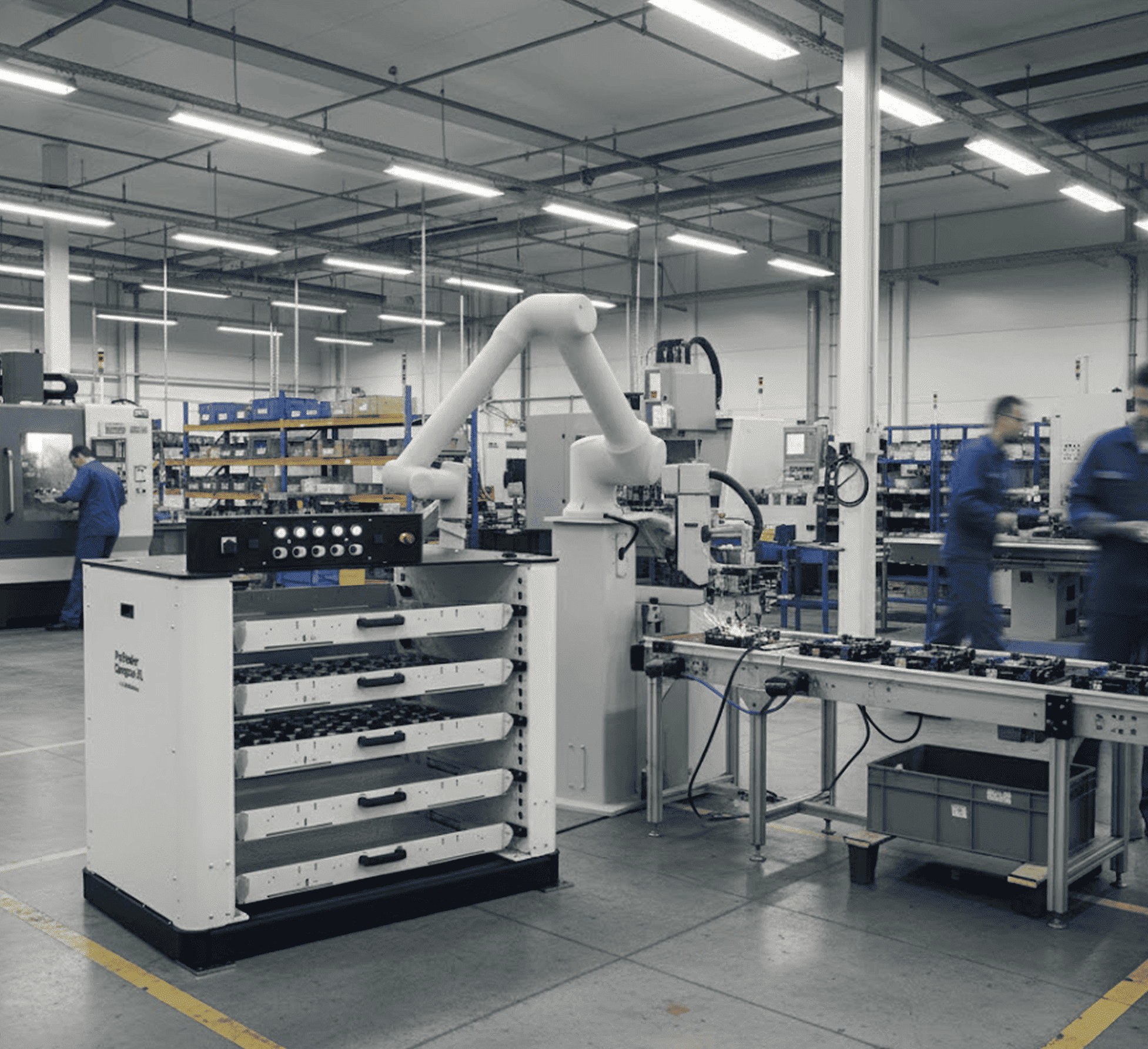
Most automation projects start the same way: a manufacturer looks at a standard cobot cell — a palletizer, a tending feeder, a welding workstation — and it almost fits. The payload is right. The reach is right. But the part has an awkward overhang the gripper can't quite reach, or the available floor space is 200 mm narrower than the standard footprint, or the robot brand on order isn't one the off-the-shelf bracket was designed around.
This is the exact moment where most automation projects either stall or get expensive — because the buyer assumes the only options are "accept the compromise" or "commission a fully bespoke system from scratch," and neither is appealing. In reality, there is a middle path that most manufacturers don't know exists: targeted customization of a proven platform, engineered specifically to close the gap between what's standard and what your application actually needs.
This guide explains when that middle path makes sense, what a genuine custom automation engineering process looks like, what it costs, and how long it realistically takes — using the EasyRobotics Easy-OEM design process as the working example throughout.
"We thought we'd need a fully bespoke cell built from zero, which our other quotes priced at three times the budget we had. EasyRobotics modified an existing ProFeeder base to fit our oversized blanks instead — same proven reliability, just engineered for our actual part." — Henrik L., Plant Engineer, EasyRobotics Customer
When Standard Doesn't Fit — How to Tell the Difference
Not every awkward fit is a genuine reason to go custom. The first useful exercise is separating real constraints from preferences, because the cost and timeline implications are very different.
A genuine constraint is something physically immovable: your facility's ceiling height, the exact footprint of an existing CNC machine you must tend, a part geometry with a feature that no standard gripper can grip, or a robot brand your maintenance team already supports and won't change. These are facts about your operation, not preferences, and a standard product that ignores them simply will not work.
A preference, by contrast, is something flexible dressed up as a requirement — "we'd prefer a slightly different colour," or "we'd like the control panel on the other side," where the underlying function works fine either way. Preferences are usually cheaper to accommodate within a standard product's existing configuration options than to engineer as a genuine customization.
The practical test: if a standard EasyRobotics platform — the ProFeeder range, the EasyPalletizer family, or the EasyWeld Station — covers roughly 80% or more of your requirement and fails on one or two specific dimensions, that is almost always a targeted modification project, not a from-scratch design. Only when the application is fundamentally unlike anything in the standard range does a complete bespoke build become the right call.
What "Customizable Industrial Automation" Actually Means
Customizable industrial automation solutions are tailored robotic systems engineered to fit a specific manufacturing process — CNC machine tending, palletizing, welding, or assembly — where the part geometry, robot model, workspace, or environmental requirement falls outside a standard product's design envelope. The goal is always the same: deliver the reliability and proven engineering of a production-tested platform, adapted precisely to the one or two dimensions where your application genuinely differs from the norm.
At EasyRobotics, this work is handled by the Easy-OEM engineering team — mechanical designers and senior automation engineers with more than 15 years of combined experience in robotics and automation, working in SolidWorks for mechanical modelling and KeyShot for visualization. The team's brief covers three distinct types of project: modifying an existing EasyRobotics product to fit a specific robot, workspace, or production flow; designing entirely new mechanical assemblies and fixtures for an application with no standard equivalent; and producing 3D models, technical drawings, and renderings for internal decision-making or manufacturing partners.
The unifying design principle across all three project types is manufacturability — every custom component is engineered to be robust, straightforward to assemble, and realistic to produce at the volumes required, rather than a one-off prototype that looks good in a rendering but is fragile or expensive to build repeatably.
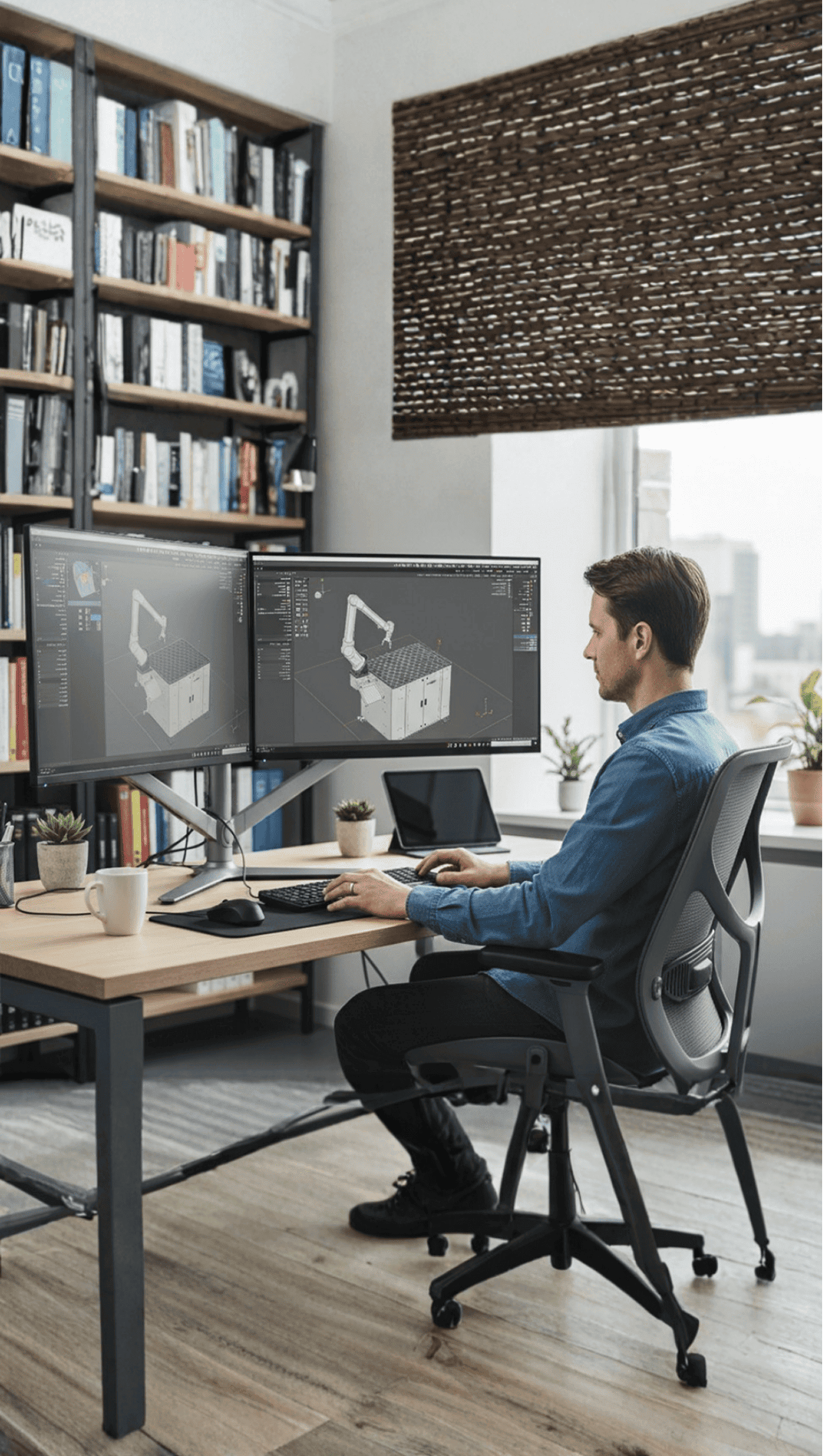
Easy-OEM mechanical design — 3D modelling, motion simulation, and manufacturability review for tailored automation projects
How the Custom Automation Design Process Actually Works
A common reason manufacturers avoid custom automation altogether is the fear of an open-ended, unpredictable engineering process with no clear cost or timeline until the very end. A well-run custom automation project should never feel like that — every stage has a defined output and a clear decision point before moving to the next.
Step 1 — Customer Contact and Scope Definition
The process begins with a technical conversation, not a sales pitch. The engineering team needs specifics: load capacity, robot type and model, working envelope dimensions, the interface to your existing equipment, and any environmental requirements such as washdown compatibility, temperature range, or hazardous area classification. The more precisely these are defined upfront, the more accurate the resulting quotation will be.
Step 2 — Project Evaluation and Quotation
Based on the defined scope, EasyRobotics estimates the engineering hours required and provides a transparent quotation. This stage starts with a fixed initial evaluation fee of €300, with the ongoing hourly engineering rate defined once the project scope is properly understood. Once approved, a detailed project timeline is prepared before any design work begins — so you know what you're committing to before the clock starts.
Step 3 — Design and Engineering
Engineers build 3D models and mechanical assemblies in SolidWorks, using accurate motion modelling to confirm every component fits the specified robot, workspace, and process. This stage includes structural verification and motion simulation to catch interference or load problems before manufacturing, interface and collision checks against your existing equipment, and design-for-manufacturability reviews to ensure the resulting parts can actually be built reliably and repeatably.
Step 4 — Visualization and Communication
Before committing to manufacturing, EasyRobotics produces high-quality renderings and animations using KeyShot Studio, so you can visualize the finished product and confirm it matches expectations. These renderings serve a second purpose beyond approval — they double as sales and marketing materials, internal decision-making aids, and customer-facing presentation assets if the custom cell becomes part of your own product offering.
Step 5 — Manufacturing Support and Delivery
Depending on the scale of the project, delivery can take several forms: a complete design package (3D models, 2D drawings, and bills of materials) if you intend to manufacture in-house or through your own supplier, prototype or pre-assembly support, or a complete turnkey mechanical system ready to integrate with your robot and production line. Smaller customization projects are typically delivered within one to two weeks; more complex developments can extend up to two months. Regular progress updates and revision reviews continue throughout.
📋 The Custom Automation Process at a Glance
1. Scope definition — load capacity, robot type, working envelope, interface, environment
2. Quotation — €300 initial evaluation fee, then a defined hourly engineering rate
3. Design — SolidWorks 3D modelling, motion simulation, manufacturability review
4. Visualization — KeyShot renderings for approval before manufacturing begins
5. Delivery — design package, prototype, or complete turnkey system (1–2 weeks for modifications, up to 2 months for complex builds)
Modification vs Ground-Up Design: Which Does Your Project Need?
The single biggest cost and timeline lever in any custom automation project is whether the work starts from an existing, proven platform or from a genuinely blank design sheet. Understanding which category your project falls into before requesting a quote will dramatically sharpen the conversation with any automation engineering team.
Platform Modification
This is the more common — and more cost-effective — path. A standard EasyRobotics product, such as the ProFeeder X for an oversized part, or the EasyPalletizer Flex for an unusual pallet format, already has a proven mechanical base, tested motion envelope, and established manufacturing process. Modification work adapts specific elements — tray dimensions, mounting brackets, fixture geometry, robot interface — while preserving everything that already works. This route is faster, cheaper, and lower-risk because most of the engineering validation has already been done on the base platform.
Ground-Up Design
This is appropriate when the application has no reasonable standard equivalent — an entirely novel process, an unusual combination of payload and reach, or a facility constraint that no existing platform's architecture can accommodate even with modification. Ground-up design requires the full structural verification, motion simulation, and manufacturability review process applied to a completely new mechanical concept, which is why these projects sit at the upper end of the one-to-two-month delivery range and command a correspondingly larger engineering hour estimate.
In practice, the large majority of customer enquiries that initially sound like they need a ground-up design turn out, after the scope definition conversation, to be platform modifications. It is always worth having that conversation before assuming the more expensive path is the only option.
Common Applications That Drive Customization Requests
Certain categories of requirement come up repeatedly across customization projects. Recognising your own situation in these patterns is often the fastest way to estimate roughly which path — modification or ground-up — your project will need.
• Oversized or unusually shaped parts
Standard tray and feeder dimensions cover the majority of CNC blanks and finished parts, but components with significant overhang, unusual cross-sections, or dimensions beyond the standard range need tray, fixture, or gripper modifications to the base ProFeeder or EasyWork platform.
• Robot brands or models outside the standard bracket range
EasyRobotics products are designed for broad compatibility, but a newly released robot model or a less common brand may need a custom mounting bracket and interface design before it integrates cleanly with a standard cell.
• Constrained or irregular floor space
Older facilities, retrofitted production lines, and shared workspaces often present footprint constraints that don't match a standard product's dimensions. Modifying the base structure or mobility configuration is usually more practical than redesigning the entire layout of the production area.
• Specific environmental or hygiene requirements
Food-grade, pharmaceutical, or washdown environments often require material changes (stainless steel rather than mild steel), sealed enclosures, or specific surface finishes that go beyond a standard product's default specification.
• Integration with existing, non-standard equipment
Tending a legacy CNC machine, an unusual conveyor interface, or a proprietary fixture system from another supplier often requires custom interface design — even when the robot cell itself could otherwise be entirely standard.
"The renderings before manufacturing made the whole process feel low-risk. We could see exactly what we were getting and request changes before a single part was cut." — Camille D., Operations Director, EasyRobotics Customer
Is a Custom Solution Right for Your Application?
✅ Custom Automation Is Likely the Right Call If You Have…
• A part geometry, weight, or size that falls outside standard product specifications
• A robot brand or model not covered by standard mounting interfaces
• A facility constraint (floor space, ceiling height, existing machine footprint) a standard cell can't fit
• A specific hygiene, safety, or environmental requirement beyond default specifications
• An existing piece of non-standard equipment the cell must interface with
• A standard product that covers most, but not all, of your application requirements
⚠️ Consider a Standard Product First If…
• Your part, robot, and floor space all fall within published specifications for an existing EasyRobotics product
• The only difference from standard is colour, branding, or minor cosmetic preference
• You need a working cell within days — modification and ground-up design both require lead time a standard, in-stock product does not
Frequently Asked Questions
🔗 Related EasyRobotics Resources
• Custom Automation Solutions — full overview of the Easy-OEM engineering service
• ProFeeder Range — modular CNC tending platform, common starting point for modifications
• EasyPalletizer Flex — reconfigurable palletizing platform built for evolving requirements
• Robotic Workstation Guide — how to choose the right standard platform before considering customization
• Contact EasyRobotics — start a scope definition conversation with the Easy-OEM team
Conclusion
The choice is rarely "standard product or expensive bespoke build from scratch." For the large majority of manufacturers whose application almost fits a standard cobot cell but not quite, the right answer is a targeted modification of a proven platform — preserving the reliability and tested engineering of an established design while closing the specific gap your application presents. This is faster, lower-risk, and very often considerably cheaper than starting from a blank design sheet.
A genuine ground-up design remains the right call for applications with no reasonable standard equivalent — but that is the exception, not the default starting assumption. The only way to know which category your project falls into is a precise scope definition conversation before any engineering work begins. If your standard automation options are close but not quite right, that conversation is the next step — and EasyRobotics' Easy-OEM team is available to have it, with a clear quotation before any commitment is made.
Have an Application That Almost Fits — But Not Quite?
Talk to the EasyRobotics Easy-OEM team. Define your scope, get a transparent quotation,
and see whether a modification or full custom design is the right path — at low upfront cost.