Automotive Parts Automation Without
an OEM-Sized Budget
Where modular cobot cells actually fit in an automotive supply chain —
CNC tending, welding, and end-of-line palletizing.
Search "automotive manufacturing automation" and almost everything you find is written for the OEM: the assembly plant running six-axis robots on a fixed line, installed by a systems integrator over an eighteen-month project. That's a real and important part of the automotive industry — but it's not where most of the parts in a car actually get made.
Behind every OEM sits a chain of Tier 2 and Tier 3 suppliers: machine shops cutting brackets and housings, fabrication shops welding subframes and mounts, and packaging lines palletizing finished components before they ship. These operations run smaller batches, more part numbers, and tighter margins than the OEM plant upstream — and for a long time, they were also the operations that couldn't justify a traditional robotics integration project.
That's the gap modular cobot cells were built to close. Instead of a custom-engineered line sized for one part number, a supplier gets a plug-and-play cell that handles a family of parts and gets reprogrammed, not rebuilt, when the job changes. Three processes account for most of where that automation actually lands on an automotive supplier's floor: CNC machine tending, welding, and end-of-line palletizing.
The OEM assembly line and the Tier 2 machine shop feeding it are both "automotive manufacturing" — but they need completely different kinds of automation.
CNC Machine Tending: The Entry Point for Most Suppliers
A large share of automotive components — brackets, housings, shafts, fittings — start life as a machined part on a CNC lathe or mill. In a manual-tending shop, an operator loads a blank, waits for the cycle, unloads the finished part, and repeats. It's exactly the kind of repetitive, geometrically consistent task that CNC machine tending automation is built for.
For automotive job shops specifically, the appeal of a modular feeder like ProFeeder isn't raw throughput — it's flexibility across part numbers. Automotive component contracts rarely mean one part running forever; they mean several related parts on rotating schedules. A tray-based cell with quick-change tooling can switch between part families without the changeover time a dedicated hard-automation line would need, which matters when the next work order on the schedule is a different bracket entirely.
Because the cell is mobile on lockable castors, it can also follow the work — moved from one CNC machine to another as priorities shift during a shift, rather than being permanently bolted to a single spindle.
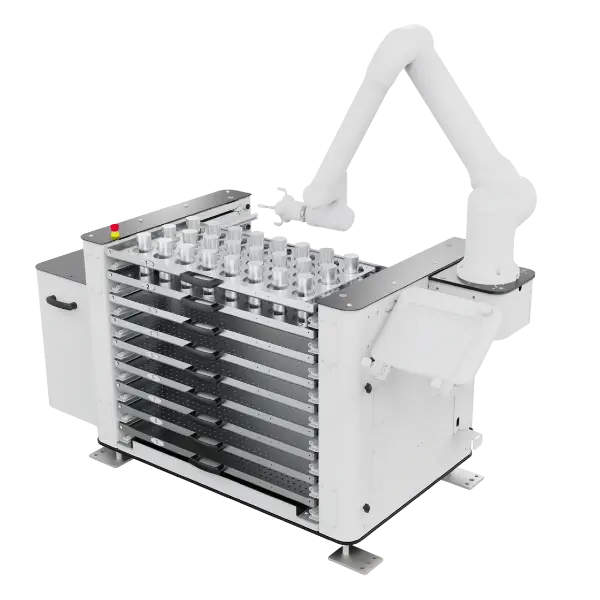
ProFeeder S — tray-based CNC tending, reconfigurable between automotive part families
Welding: Where Guarding Stops Being Optional
Brackets, mounts, and subframes need to be welded, and this is the automotive process where a cobot cell looks most different from a simple pick-and-place setup. An arc is a hazard the robot itself doesn't create but the process does, so unlike a light-payload tending task, a welding cell almost always needs physical guarding rather than relying on the cobot's built-in force limiting alone.
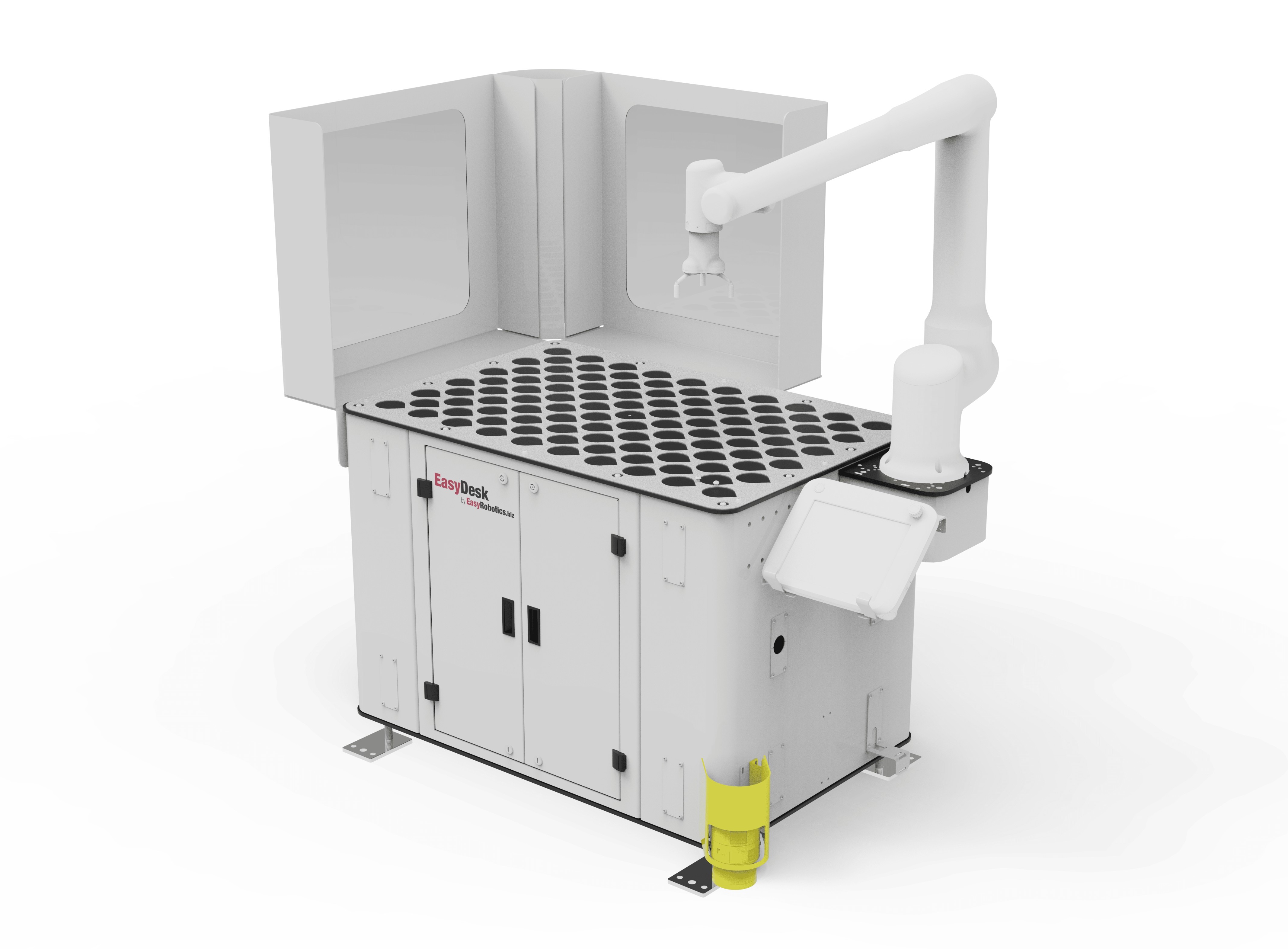
The EasyWeld Station, built around a precision Siegmund welding table, is designed with that in mind — it pairs naturally with the EasyEnclosure or the newer EasyDesk Enclosure to bring a complete, guarded welding cell rather than a bare robot arm that still needs a safety solution designed around it. We covered the guarding decision itself, including what ISO 10218 and ISO/TS 15066 actually require, in our cobot safety enclosure guide.
For automotive fabrication specifically, consistent weld placement is as much a quality issue as a productivity one — dimensional and cosmetic tolerances on visible or structural brackets are typically tighter than general fabrication work, and a robot's repeatable torch path reduces the part-to-part variation that a human welder introduces over a long shift.
End-of-Line Palletizing: The Process Everyone Forgets to Automate First
Once parts are machined or welded, they still have to be packed and staged for shipment to the next tier of the supply chain — and that lifting and stacking is often the last manual step left after tending and welding have already been automated. The EasyPalletizer range automates this end-of-line step, building consistent pallet patterns without the repetitive lifting that tends to be one of the higher-injury-risk tasks on a packaging line.
Automotive parts vary widely in shape — from small machined fittings to larger stamped brackets — so a palletizing cell that can be configured to a specific part geometry and pallet pattern, rather than a fixed one-size-fits-all conveyor system, tends to fit small and mid-sized supplier operations better than large fixed palletizing lines built for a single SKU.
💡 Where Each Process Typically Fits
• CNC Machine Tending: Machined brackets, housings, shafts — high part-mix job shops
• Welding: Brackets, mounts, subframes — always paired with physical guarding
• Palletizing: End-of-line packing before shipment to the next supply chain tier
• All three can share the same mobile, brand-agnostic cobot base across a small plant
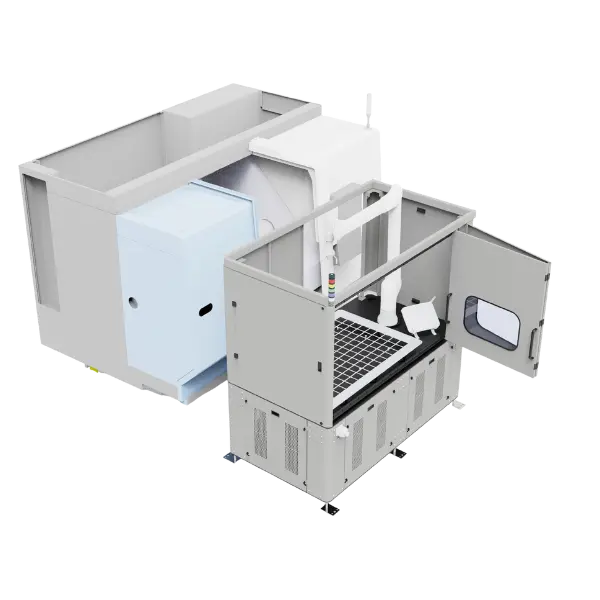
Modular cells are designed to be relocated across machines and part numbers as automotive work orders change
Why Tier 2/3 Suppliers Need a Different Automation Model Than OEMs
An OEM assembly line is designed around a single vehicle platform running for years, which justifies a fixed, high-speed robot line engineered specifically for that model. A Tier 2 or Tier 3 supplier's reality looks nothing like that: several customer programs at once, part numbers that change with model-year updates, and order volumes that don't always justify a dedicated line per part.
That mismatch is exactly why hard automation has historically been a harder sell further down the automotive supply chain, even though the underlying tasks — tending, welding, palletizing — are just as repetitive as anything on the OEM floor. Modular, brand-agnostic cobot cells solve for the actual constraint: not raw speed, but the ability to be redeployed, reprogrammed, and moved between machines and part families without a new integration project each time.
✅ Automation Fits Well If Your Automotive Operation Has…
• Multiple related part numbers running on rotating schedules rather than one part forever
• CNC machines, welding stations, or a packaging line sitting idle during breaks or shift changes
• Difficulty hiring or retaining operators for repetitive tending, welding, or lifting tasks
• Parts with consistent clamping or fixture geometry across the part family
• A need to keep capital flexible across more than one customer program
Operations closer to true OEM assembly-line scale, or with highly specialised fixturing needs, are usually better served by a customised automation solution — EasyRobotics engineers can assess which model fits at no charge.
Building the Full Cell, Not Just One Station
Most automotive suppliers don't automate one process in isolation — tending, welding, and palletizing tend to get tackled in sequence as confidence builds. Because EasyRobotics' product range shares the same modular design, each addition integrates with what's already running rather than requiring a separate system.
Start with Tending: ProFeeder S or the compact ProFeeder Compact are common entry points for a first automotive automation project on a single CNC machine.
Add Welding: The EasyWeld Station, guarded with the EasyDesk Enclosure, brings consistent weld quality to brackets and subframes.
Finish with Palletizing: An EasyPalletizer Pro or EasyPalletStation automates the last manual step before parts ship to the next tier.
Because all three share compatibility with Universal Robots, Doosan, FANUC CRX, ABB, and KUKA cobots, a supplier isn't locked into a single robot brand as the automation footprint grows across the plant.
Frequently Asked Questions
Conclusion
Automotive automation content tends to assume the OEM assembly line. Most automotive parts, though, pass through a Tier 2 or Tier 3 supplier first — a machine shop, a weld cell, a packaging line — where the constraints are different: more part numbers, smaller batches, and no appetite for an eighteen-month integration project.
Modular cobot cells for CNC tending, welding, and palletizing were built for exactly that reality — automation that gets reprogrammed rather than rebuilt when the next work order lands on the schedule.
Supplying the Automotive Industry? Let's Find the Right Fit
Talk to an EasyRobotics automation specialist about your part mix, batch sizes,
and where a modular cobot cell fits your production line — at no charge.