Warehouse Palletizing Automation:
Where Cobots Fit
Seasonal peaks, rotating SKUs, and a labor market that won't stay stable —
here's a realistic look at cobot palletizing in warehouse operations.

A warehouse doesn't run like a factory floor, and automation content aimed at manufacturers doesn't always translate cleanly. A factory usually runs the same part, or a small rotation of parts, for months at a stretch. A warehouse or distribution center deals with a shifting SKU mix, seasonal volume that can double or triple for a few weeks a year, and a workforce that turns over faster than almost any other role in logistics: end-of-line palletizing.
Stacking boxes onto pallets all shift is repetitive, physically demanding, and one of the more injury-prone tasks in a DC — which is exactly why it's also one of the hardest roles to keep staffed. Collaborative robot palletizing exists to take that specific task off the floor, without requiring the fixed, single-SKU automation line that a factory assembly operation might use.
A warehouse doesn't need automation shaped like a factory line — it needs automation that can keep up with a SKU mix that changes every week.
Why End-of-Line Palletizing Is the Right Place to Start
Of everything happening in a modern DC, palletizing is one of the more automatable tasks — it sits at a fixed point in the workflow, the inputs (boxes or cases coming off a line or conveyor) are relatively consistent even when the SKU changes, and the output (a stable, correctly patterned pallet) is easy to define and verify.
The EasyPalletizer is built specifically around that end-of-line handoff. Its weight and dimensions depend on the selected base, pedestal and stainless-steel configuration. Four detection pins per pallet side help confirm correct pallet positioning before palletizing begins.
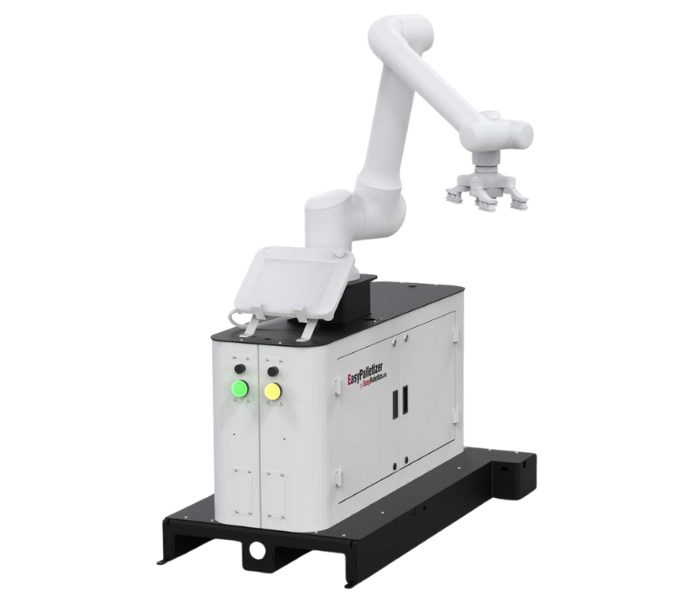
Four detection pins per pallet side confirm correct docking before palletizing starts
Handling a Rotating SKU Mix, Not a Single Product Line
The dual-pallet platform provides two pallet positions, supporting organised pallet changeovers and different operating sequences. While the robot works with the configured active position, the other pallet position can support staging or exchange according to the validated cell sequence. Floor-level loading and unloading keeps the physical footprint simple, and load transfer stations can connect the palletizing step with conveyors or other fixed equipment.
Compatible products and pallet patterns can be changed through stored recipes, reducing dependence on hard mechanical tooling. Major differences in box dimensions, weight, packaging rigidity or pallet height may still require gripper, conveyor, reach or safety adjustments.
💡 Quick Facts
• EasyPalletizer provides two integrated pallet positions with docking detection
• Fixed pedestal heights of 835 mm and 1200 mm align with different conveyor and robot setups
• A stainless steel (AISI304) version is available for food, beverage, and pharma DCs
• Compatible with Universal Robots, FANUC, Doosan, and Robotiq cobots
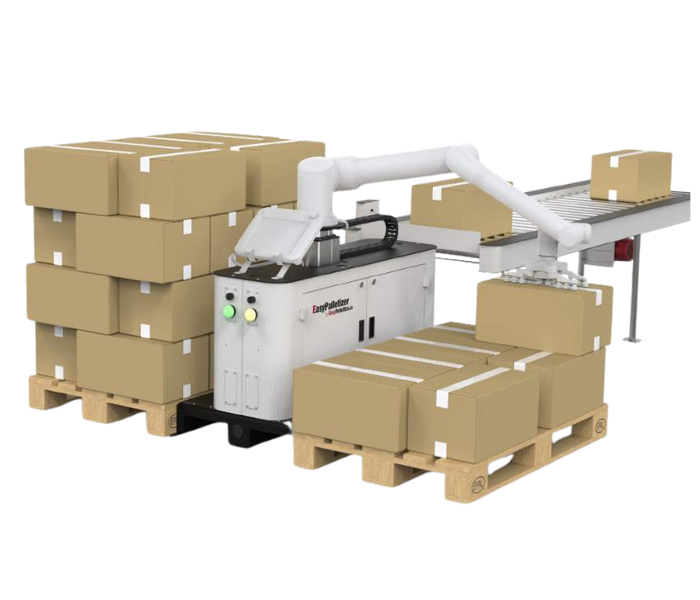
Fixed pedestal configurations align the cell height to existing conveyor and pack-line setups
Where a Fixed Cobot Cell Fits — and Where It Doesn't
It's worth being direct about scope. A cobot palletizer has a fixed maximum throughput — it will not scale infinitely the way adding a dozen temporary workers during a holiday peak can. What it offers instead is consistency: the same output, at the same quality, whether the labor market is tight or the shift is fully staffed.
It's also worth being clear about what EasyRobotics does and doesn't provide. EasyPalletizer automates the palletizing step itself — building and staging pallets at the end of a line. It doesn't include autonomous mobile robots (AMRs) for moving those pallets around the warehouse floor once built; plenty of DCs pair fixed palletizing cells like this with AMR fleets from other vendors for that internal transport leg, but AMRs sit outside what EasyRobotics builds.
✅ Cobot Palletizing Fits Well If Your Warehouse Has…
• A rotating SKU mix rather than one product running continuously
• High turnover or difficulty staffing repetitive lifting roles
• A steady baseline volume, even if it spikes seasonally
• Boxes or cases with reasonably consistent dimensions and rigidity
• A need for an available AISI 304 stainless-steel platform configuration
For irregular, non-rigid, or highly variable packaging, or for warehouses that need AMR-based internal transport as part of the project, a customised automation solution is worth discussing directly with EasyRobotics engineers, at no charge.
Building From Palletizing to a Wider Warehouse Automation Plan
Palletizing can be a practical first automation step because it is concentrated at a defined point in the operation. Review the EasyRobotics palletizing solutions and the automated palletizing guide to understand the wider cell requirements. Use the ROI calculator with your actual shifts, case volume and labor inputs before requesting a proposal.
The final platform should be selected from the application. Compare the standard EasyPalletizer with EasyPalletizer Pro when extended reach is important and EasyPalletizer Flex when flexible placement or relocation between suitable lines is a priority.
Frequently Asked Questions
Conclusion
Warehouse operations don't need factory-style automation — they need automation that keeps up with a SKU mix that shifts constantly and a labor pool that's hard to keep staffed for repetitive lifting work. Cobot palletizing addresses exactly that slice of the operation: consistent, reprogrammable, and self-contained enough to add without redesigning the rest of the DC.
It isn't a replacement for a full warehouse automation strategy involving AMRs or storage systems — but as a first, high-confidence step, end-of-line palletizing is usually the right place to begin.
Evaluating Automation for Your Warehouse Floor?
Share your case dimensions, pallet patterns, cases per minute and warehouse layout.
Our automation specialists will help identify a suitable configuration.