Robotic Palletizing Solutions for Smart Manufacturing
Introduction to Robotic Palletizing
Robotic palletizing systems automate the repeated task of picking products and placing them onto pallets in a programmed pattern. For manufacturers and logistics operators, they can help maintain a consistent production flow and reduce manual lifting at the end of the line.
Food and beverage producers, pharmaceutical manufacturers, and other businesses use palletizing automation to handle packaged goods. This guide explains how the systems work and what to assess before selecting a solution.
What is a Robotic Palletizer?
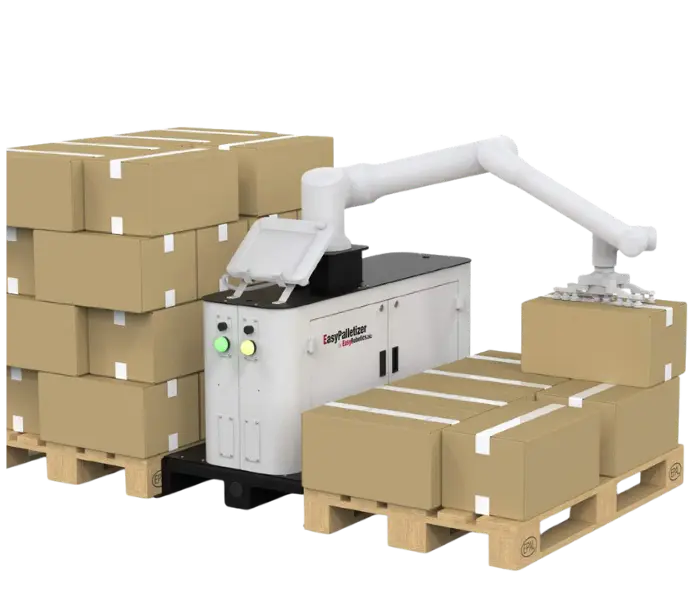
A robotic palletizer uses a robot arm and suitable gripper to place boxes, bags, or other packaged products onto a pallet. The product, tooling, pallet pattern, and cell configuration must work together. Explore EasyPalletizer Basic as one starting point for discussing your application.
Robotic systems can be programmed for different stacking patterns and product formats. The required changeover work depends on the gripper, packaging, robot reach, and control software.
How Does a Robotic Palletizing System Work?
A typical automated palletizing system includes:
- Industrial robot arm or cobot
- End-of-arm tooling (grippers, vacuum systems)
- Conveyor systems
- Control software & sensors
The process:
- Products move via conveyor to the palletizing station
- The robot picks items using a gripper or vacuum tool
- It places them onto pallets in a predefined pattern
- Completed pallets are moved for storage or shipping
Some applications also use vision systems to locate or check products before picking. The required sensors and handling method depend on how products arrive at the station.
Key Benefits of Robotic Palletizers
1. Boosts Productivity
Automated stacking can help keep pace with upstream production. Actual throughput depends on product size and weight, the picking sequence, and pallet changeovers.
2. Delivers Consistency
A programmed pattern supports repeatable placement. Packaging condition, grip reliability, and the chosen pattern still affect load stability.
3. Cuts Labor Costs
Reducing time spent on manual stacking can allow operators to focus on other tasks. Savings depend on staffing, utilization, and the complete operating cost.
4. Makes Work Safer
Automating suitable lifting tasks can reduce manual handling. Safe operation depends on the complete application and its risk assessment.
5. Adapts Easily
Stored recipes can support different pallet patterns. New products may require changes to tooling, settings, or the stacking sequence.
6. Saves Space
Compact configurations can suit restricted production areas. Allow space for product infeed, pallet access, and the required protective measures.
Types of Robotic Palletizers
1. Collaborative Palletizers (Cobot Palletizers)
Use collaborative robot arms for suitable payloads and production rates. Working near people depends on the assessed cell, tooling, product, and operating conditions.
2. Industrial Robotic Palletizers
Often considered for higher production rates or heavier loads, with a cell configured around the application.
3. Gantry/Cartesian Palletizers
Use movement along linear axes to position products within a defined stacking area.
Where You'll Find Robotic Palletizers
- Food and beverage companies
- Pharmaceutical plants
- Warehouses
- Manufacturing floors
- Consumer goods operations
What Matters Most in a Robotic Palletizer
Compare product dimensions and weight, robot payload including the gripper, required products per minute, pallet size, stacking height, and available floor space. Also assess packaging grip, pattern changes, pallet replacement, and any required conveyor or production-system connections.
| Feature | Manual Palletizing | Robotic Palletizing |
|---|---|---|
| Speed | Depends on staffing and workflow | Depends on the cell and product |
| Accuracy | Depends on handling and training | Programmed, repeatable placement |
| Labor | Regular manual stacking | Supply, monitoring and pallet changes |
| Safety | Manual handling controls needed | Application risk assessment needed |
| Cost | Lower equipment cost; ongoing labor | Installation and operating costs |
ROI of Robotic Palletizing
Estimate payback from the total installed cost and expected annual net savings. Include the robot, tooling, workstation, integration, training, maintenance, and energy use. Compare these costs with your current staffing and achievable production gains; payback varies by application and operating hours.
Why Choose EasyRobotics for Palletizing Automation?
At EasyRobotics, we specialize in flexible robotic palletizing solutions designed for modern manufacturing environments.
- Modular palletizing configurations for different applications
- Options for different pallet layouts and production needs
- Application planning around throughput, space, and handling requirements
- Robot compatibility confirmed for the selected system
Plan Your Palletizing Project
To assess a suitable palletizing solution, share your product dimensions and weight, required production rate, pallet size, target stacking height, and available floor space. Discuss your palletizing project with EasyRobotics to review the configuration and integration requirements.