Robotic Depalletizing:
How Cobots Automate Pallet Unloading
Your dock unloads pallets all day, by hand. See how one collaborative robot palletizer
can take that job over — without buying a second machine.

Most automation conversations start at the end of the line: stacking finished cases onto a pallet, wrapping it, and shipping it out. Fewer start at the other end — the receiving dock, where pallets of raw materials, components, or incoming stock arrive and someone still has to take them apart, box by box, by hand.
That job is called depalletizing, and it's usually the least automated step in an otherwise modern facility. It's repetitive, it's heavy, and it's one of the more common sources of manual-handling injuries on a production floor — yet it rarely gets the same automation attention as the palletizing side.
Robotic depalletizing closes that gap. And because a cobot palletizer is mechanically built to move product on and off a pallet in either direction, most manufacturers don't need a separate machine to do it — the same unit that palletizes your outbound cases can unload your inbound ones too.
"We automated our outbound palletizing first and assumed depalletizing would need a whole separate project. It didn't — the same EasyPalletizer just runs the sequence in reverse for our incoming totes." — Plant Manager, EasyRobotics Customer
What Is Robotic Depalletizing, Exactly?
Depalletizing is the mirror image of palletizing. Instead of a robot picking cartons off a conveyor and stacking them onto a pallet in a set pattern, it picks cartons off a loaded pallet, layer by layer, and places them onto a conveyor, a workstation, or a transfer station for the next process step.
It shows up most often at three points in a facility: on the receiving dock unloading supplier pallets, at the start of a production line feeding raw components into machining or assembly, and in warehousing where mixed pallets need to be broken down into individual SKUs for picking.
In each case, the manual version of the job looks the same — someone standing at a pallet, repeatedly bending, lifting, and twisting to move boxes one at a time onto a cart or conveyor, for hours at a stretch.
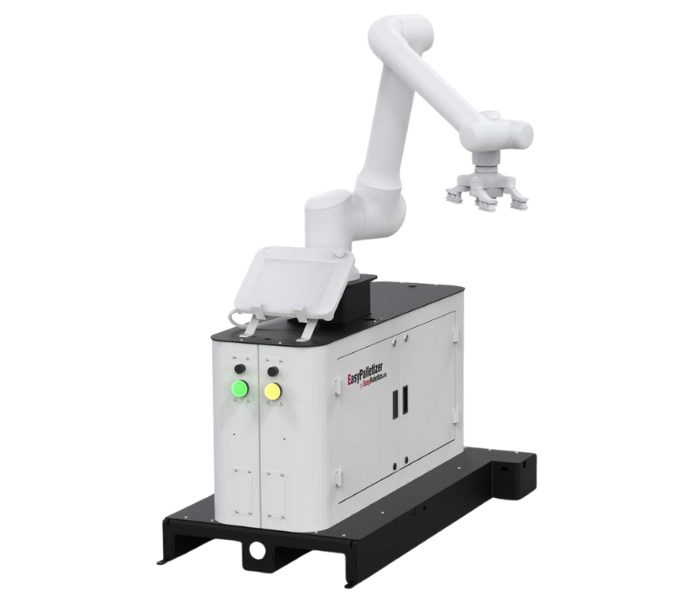
Pallet detection pins confirm correct docking before the robot begins unloading or loading a pallet
The Hidden Cost of Manual Pallet Unloading
Manual depalletizing rarely gets flagged as a priority because no single box feels heavy. It's the repetition that adds up — and it adds up in three specific ways.
• Manual-Handling Injuries
Repetitive lifting and twisting at pallet height is one of the leading causes of lower-back strain in warehousing and manufacturing. Every reported injury brings direct medical cost, lost shift time, and often a period of light duty for the affected worker.
• Receiving Dock Bottlenecks
Incoming trucks don't wait for your team to catch up. When depalletizing is manual, receiving throughput is capped by how fast people can physically unload — which becomes the ceiling on how much material can enter the plant in a shift.
• Inconsistent Handling of Fragile or Heavy Goods
Fatigue late in a shift changes how carefully product is handled. Dropped cartons, damaged packaging, and mishandled stock at the unloading stage are quality issues that get blamed on suppliers when the real cause is how the pallet was broken down.
💡 Quick Facts
• Manual depalletizing is typically one of the most injury-prone repetitive tasks on a production floor
• A single collaborative robot palletizer can run both directions — loading and unloading — on the same unit
• EasyPalletizer supports floor-level palletizing and depalletizing, with no ramp or pit required
• EasyRobotics customers typically see ROI in 6 to 18 months
How the EasyPalletizer Handles Depalletizing
The EasyPalletizer was built as a two-way system from the start, not adapted after the fact. It's a 300 kg (robot excluded) collaborative robot palletizer used across pharmaceuticals, food and beverage, electronics, and metalworks — and depalletizing runs on the same hardware as palletizing, with no separate module to buy.
What Makes It Work for Unloading, Not Just Loading
• Floor-Level Docking
Pallets dock directly at floor height on each side of the unit, so incoming pallets can be wheeled straight in without a ramp, lift, or pit — the same simplicity that makes loading easy also makes unloading easy.
• Four-Point Pallet Detection
Each side uses four detection pins to confirm the pallet is correctly docked before the robot starts, whether it's stacking a finished pallet or picking apart an incoming one. This prevents misaligned picks that damage product or drop cartons.
• Dual Palletizing System
Because the EasyPalletizer supports simultaneous operations on both sides, one side can be receiving an unloaded pallet while the other builds an outbound one — useful for facilities where inbound and outbound flow happen close together.
• Any Major Robot Arm
It integrates with Universal Robots, Fanuc, Doosan, and Robotiq arms, so if you already run one of these brands elsewhere in the plant, depalletizing doesn't require learning a new robot ecosystem.
• Mobile, Not Fixed
The unit is mobile and compact enough to reposition between the receiving dock and a production line as needs shift — you're not locking one machine to one location permanently.
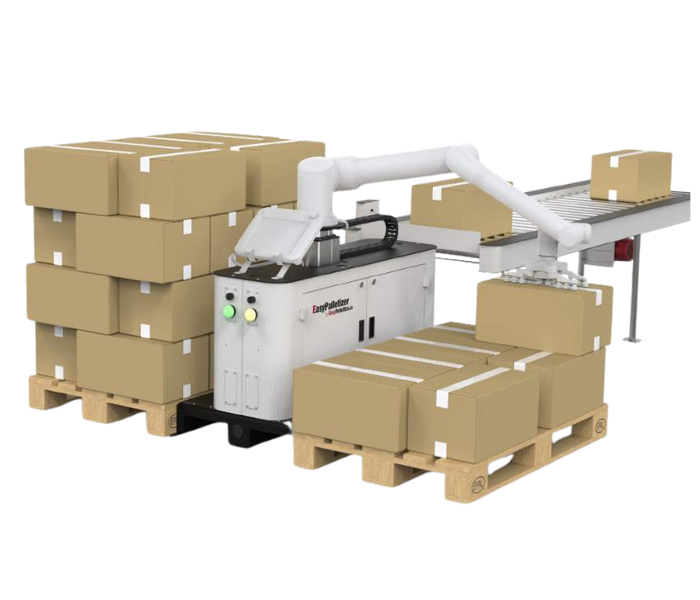
The same compact frame handles loading and unloading, so one investment covers both directions of pallet flow
What ROI Looks Like on the Unloading Side
Depalletizing ROI is usually easier to justify than people expect, because most of the cost it removes is already visible on a P&L — it's just filed under "labour" or "injury claims" rather than "automation opportunity."
Scenario: A packaging or contract manufacturing site receives 15–20 incoming pallets per shift, each manually unloaded by a dedicated team member before goods move into production or storage.
After deploying an EasyPalletizer on the receiving side, that same person shifts to overseeing two or three cells at once instead of unloading pallets by hand — while the robot handles the repetitive lifting consistently, at the same pace, shift after shift. Combined with fewer manual-handling incidents and less product damage from inconsistent handling, EasyRobotics customers typically report payback within 6 to 18 months, in line with results seen on the palletizing side of the same machine.
Use the EasyRobotics ROI Calculator to model the payback for your own receiving volume, shift pattern, and labour costs.
"The business case wasn't even about speed — it was about how many people we were rotating through the unloading role because of strain complaints. That stopped almost immediately." — Operations Lead, EasyRobotics Customer
Is Depalletizing Automation Right for Your Operation?
Depalletizing automation delivers the clearest payoff in specific conditions. Use this checklist to gauge fit before requesting a quote.
✅ Strong Candidate If You Have…
• Regular incoming pallets of cartons, cases, or boxed goods on a receiving dock or line-feed area
• Recurring manual-handling strain complaints or injury reports tied to unloading
• A receiving throughput bottleneck that limits how fast trucks can be unloaded and cleared
• Product with reasonably consistent carton or case geometry
• An existing or planned outbound palletizing project the same cobot could also support
• A goal of reducing headcount dedicated purely to repetitive lifting, not judgement-based tasks
If incoming loads are highly irregular — mixed pallets with wildly inconsistent box sizes and no fixed pattern — a customised automation solution may be a better starting point than a standard cell. EasyRobotics engineers can assess your specific pallet mix at no charge.
One Automation Investment, Both Directions
The strongest argument for automating depalletizing isn't the unloading job on its own — it's that you likely don't need to fund a second project to get it. If palletizing is already on your automation roadmap, ask whether the same machine can be specified to run both directions from day one.
Outbound Palletizing: The EasyPalletizer and EasyPalletizer Pro automate end-of-line stacking with the same dual-side, floor-level design covered here.
Mixed-SKU Flexibility: For operations depalletizing and re-palletizing varied product mixes, the EasyPalletizer Flex is built for higher pattern variability.
Load Transfer: The EasyPalletStation supports transferring product between pallets, conveyors, and mobile robots — useful where depalletizing feeds directly into another automated process.
Because every EasyRobotics system shares the same modular platform, a depalletizing cell you install today integrates cleanly with palletizing, machine tending, or welding automation you add later.
Frequently Asked Questions
Conclusion
Depalletizing tends to stay manual longer than it should, simply because it doesn't get treated as its own automation project. But with a cobot palletizer built to run in both directions, unloading incoming pallets isn't a separate investment — it's a second use of one you may already be planning.
If your receiving dock still relies on people lifting cartons off pallets by hand, that's usually the fastest-justified automation project on the floor — not because it's glamorous, but because the labour cost and injury risk it removes are already sitting in plain sight.
Ready to Automate Both Ends of Your Pallet Flow?
Talk to an EasyRobotics automation specialist about palletizing and depalletizing
on a single cobot — with a tailored quote and payback estimate, at no charge.