Robot Pedestal vs Cobot Stand:
The Complete 2026 Buyer's Guide
Every cobot cycle starts at the base. Here's how to choose a mounting solution
that won't cost you accuracy, floor space, or downtime.
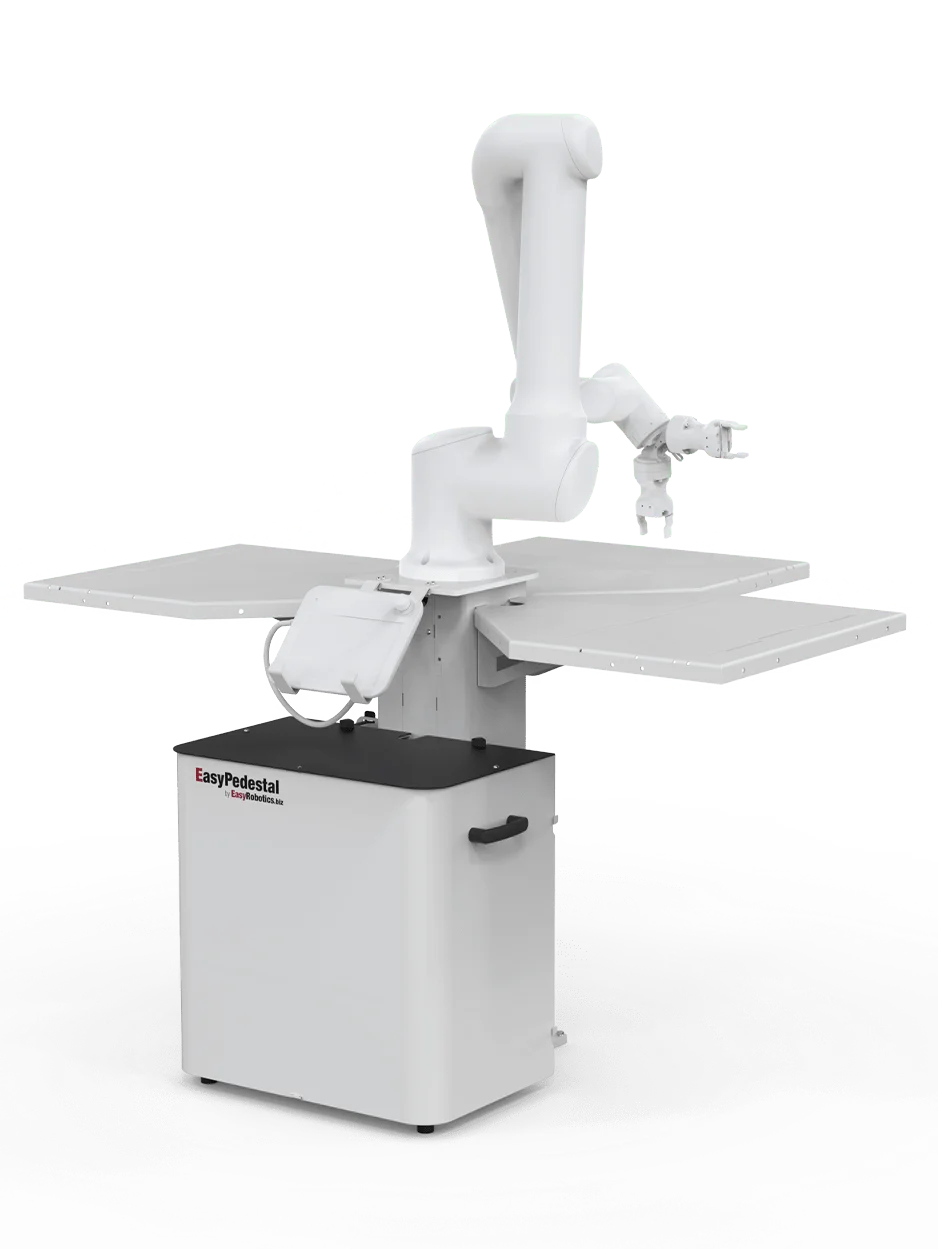
Search "robot pedestal" or "cobot stand" and you'll find dozens of products that look similar in a thumbnail but behave very differently on a factory floor. Some are little more than a weighted tripod. Others are engineered steel bases designed to hold a repeatable position through millions of duty cycles. The difference rarely shows up on day one — it shows up six months later, in drifting part placement, loosening bolts, or a cobot arm that starts missing its pick point by a few millimetres.
Before choosing a mounting base for a collaborative robot, it helps to understand what actually separates a production-grade robot pedestal from a generic cobot stand — and why that choice affects everything downstream, from CNC machine tending accuracy to long-term maintenance cost.
"We didn't think the base mattered until our first pedestal started flexing under load. Switching to a proper steel pedestal fixed our repeatability problem overnight." — Manufacturing Engineer, EasyRobotics customer
Robot Pedestal vs Cobot Stand: Is There Actually a Difference?
In everyday use, "robot pedestal," "cobot stand," and "robot workstation base" are often used to describe the same category of product, and buyers searching for one term are usually open to any of them. But there is a meaningful distinction worth knowing before you buy.
A pedestal typically refers to a floor-anchored, heavy-gauge steel column purpose-built for continuous industrial duty — designed to be bolted down and left in place for years. A stand is a broader term that can include lightweight, mobile, or improvised mounting solutions, some of which were never engineered for the repeated high-speed motion a cobot generates during a full production shift.
For applications like CNC machine tending, where a cobot must return to the exact same pick and place point thousands of times per shift, the structural rigidity of a true pedestal is not a luxury — it is what keeps the robot's programmed coordinates accurate over time.
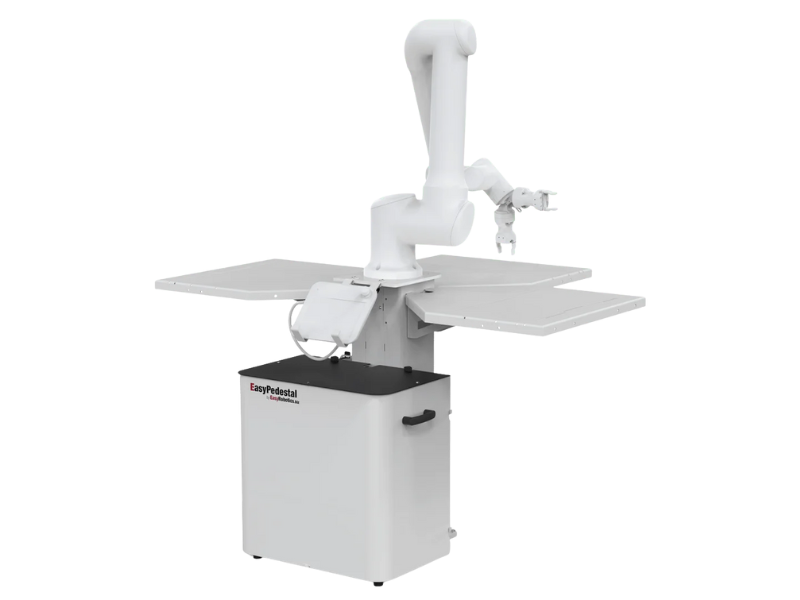
EasyPedestal's floor-mounted bracket is designed for secure anchoring in industrial environments
What to Check Before Buying a Robot Pedestal
The robot pedestal market has grown quickly alongside cobot adoption, and not every listing that shows up in a search is built for sustained industrial use. Here are the specifications that actually determine whether a pedestal will hold up in production.
• Steel Gauge and Construction
Thin sheet-metal stands can look identical to a heavy-duty pedestal in a product photo, but wall thickness determines how much a base flexes under repeated cobot acceleration and deceleration. A pedestal built from 6 mm powder-laminated steel resists that flex far better than lighter alternatives.
• Mounting Height
Height determines whether the cobot's working envelope actually reaches the machine, conveyor, or fixture it needs to tend. A 900-950 mm range suits most CNC machine tending and assembly setups, positioning the robot's base joint at an ergonomic and mechanically efficient working height.
• Cobot Brand Compatibility
Some pedestals are built around a single robot brand's mounting pattern. A pedestal with a universal T-pad bracket compatible with Universal Robots, Doosan, Kassow, and Hanwha gives you flexibility to change robot brands later without replacing the base.
• Cable and Controller Management
Loose cabling around a moving cobot arm is both a safety hazard and a maintenance headache. Pedestals with an integrated compartment for the robot controller and routed cable trays keep the workstation clean and reduce trip hazards on the shop floor.
• Floor Anchoring
A pedestal that isn't properly secured to the floor will shift over time under repeated motion. Look for a base designed for secure bolt-down mounting rather than one that relies on weight alone to stay in place.
💡 Quick Facts
• Most CNC tending applications need a mounting height between 900-950 mm
• Thin sheet-metal stands flex measurably more than 6 mm steel pedestals under repeated cobot motion
• A universal T-pad bracket supports UR, Doosan, Kassow, and Hanwha cobots on the same base
• Pairing a pedestal with a feeder system (like ProFeeder Compact) creates a complete tending cell in one footprint
Inside EasyPedestal: A Purpose-Built Robot Pedestal
EasyPedestal was engineered specifically to answer the checklist above. It is a compact, cost-effective cobot pedestal built to fixture Universal Robots, Doosan, Kassow, and Hanwha cobots on a single, standardized steel base.
Key Features of EasyPedestal
• Heavy-Duty Steel Construction
Built from 6 mm powder-laminated steel, EasyPedestal resists the vibration and flex that shorten the working life of lighter stands, keeping the cobot's positioning accurate cycle after cycle.
• Standardized 925 mm Height
A consistent 925 mm mounting height positions the cobot at an efficient working height for CNC machine tending, metalworking, and assembly applications.
• Universal Cobot Mounting
A T-pad bracket accommodates UR, Doosan, Kassow, and Hanwha cobots, so manufacturers standardizing on EasyPedestal are not locked into a single robot supplier.
• Integrated Cable and Controller Management
Internal cable routing and, in the EP Pro variants, a dedicated compartment for the robot controller keep the workstation tidy and protect sensitive components from shop-floor hazards.
• Compact, Space-Saving Footprint
A small base footprint frees up floor space for other equipment, and optional side tables add storage capacity without expanding the overall workstation size.
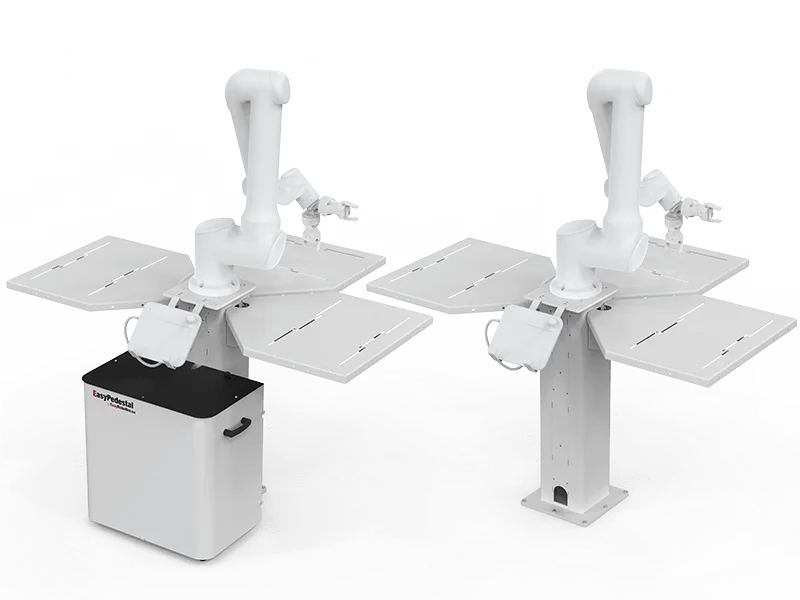
EasyPedestal's side-table configuration adds storage without expanding the workstation footprint
EasyPedestal Product Line: Choosing the Right Configuration
EasyPedestal is available in six configurations, all built on the same 925 mm steel base, so you can match the pedestal to your application's storage and controller-management needs without changing your core mounting standard.
EP Base — 52 kg, T-Pad bracket only. The lightest configuration for setups where controller housing and side storage aren't needed.
EP Base One — 64 kg, T-Pad bracket plus one side table for basic parts staging.
EP Base Three — 88 kg, T-Pad bracket plus three side tables for setups needing more staging area.
EP Pro — 80 kg, adds a dedicated compartment for the robot controller, keeping electronics protected and out of the way.
EP Pro One — 92 kg, controller compartment plus one side table.
EP Pro Three — 118 kg, the fully equipped configuration with controller compartment and three side tables — the heaviest and most rigid option in the range.
Heavier configurations aren't just about storage — added mass improves vibration damping, which is why the Pro Three variant is often specified for high-cycle CNC tending applications where positioning accuracy matters most.
Where a Robot Pedestal Pays Off
A properly specified pedestal isn't just a mounting accessory — it directly affects the outcomes manufacturers care about most.
✅ A Robot Pedestal Is the Right Fit If You Need…
• Consistent, repeatable cobot positioning across thousands of cycles
• A standardized base that supports multiple cobot brands
• A compact footprint that frees up floor space for feeders or fixtures
• Clean cable and controller management for safety compliance
• A base that can be paired with a feeder system to build a complete tending cell
Common applications include CNC machine tending, where the cobot loads and unloads a lathe or mill from a fixed pedestal position; electronics assembly, where precise, repeatable placement is critical; and general metalworking cells, where a rigid base withstands the vibration of nearby machining operations. EasyPedestal is also frequently deployed alongside the ProFeeder Compact to combine a stable cobot base with an integrated part-feeding tray in a single workstation.
Building a Complete Cobot Workstation
A pedestal is usually the starting point, not the finish line, of a cobot deployment. Once the mounting base is settled, most manufacturers add the tooling that turns a standalone robot arm into a working production cell.
Machine Tending: Combine EasyPedestal with the ProFeeder Tray or ProFeeder Compact to build a complete CNC loading and unloading cell without custom integration work.
Enclosed Cells: For applications requiring a full safety perimeter, the FlexiGuard Tending Station pairs a guarded cell with pedestal-mounted cobots for any major brand.
Broader Automation: Because EasyRobotics products share a common modular design, a pedestal installed today integrates cleanly with palletizing or welding cells added later — see the full product range for options.
Frequently Asked Questions
Conclusion
Whether you search for a "robot pedestal" or a "cobot stand," the product you actually need is the same: a rigid, properly sized, brand-flexible steel base that keeps your cobot's positioning accurate for years, not months. EasyPedestal's 6 mm steel construction, standardized 925 mm height, and universal cobot compatibility make it a straightforward, low-risk starting point for any collaborative robot deployment.
Get the base right, and everything you build on top of it — machine tending, assembly, or a full ProFeeder cell — inherits that stability from day one.
Ready to Standardize Your Cobot Mounting?
Talk to an EasyRobotics automation specialist. Get a tailored EasyPedestal quote,
configuration guidance, and a deployment plan — at no charge.