How Collaborative Robots (Cobots) Boost ROI in Small & Medium Manufacturing
Why ROI Matters More Than Ever
For small and medium-sized manufacturers, every investment decision must be justified with measurable returns. Rising labor costs, increasing competition, and unpredictable demand have forced factory owners and production managers to rethink operational strategies.
Industrial automation used to be associated with high capital investment and complex integration. However, collaborative robots (cobots) have changed this perception. Today, modular cobot automation systems allow manufacturers to automate specific processes such as CNC machine tending, palletizing, and welding without rebuilding the entire factory.
Understanding how cobot automation improves return on investment (ROI) is essential before making an automation decision.
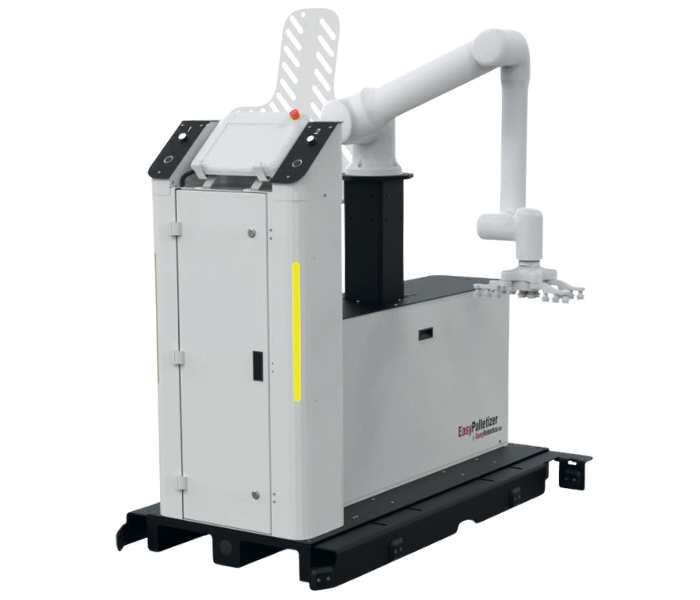
EasyPalletizer Pro
Understanding the True Cost of Manual Manufacturing
Many factories underestimate the hidden costs of manual operations. These may include:
• Overtime payments
• Production delays
• Workplace injuries
• Inconsistent output
• Errors associated with operator fatigue
• Downtime during shift changes
Measuring these costs over a full year helps manufacturers compare their current process with the total cost of a modular robot cell.
Collaborative robot automation can address repetitive work and reduce avoidable delays when the application is suitable for automation.
How Cobots Can Increase Production Output
Collaborative robots can perform repetitive handling tasks alongside other production activities. The safeguards required depend on the complete application and its risk assessment.
When integrated into CNC machine tending automation, cobots can:
• Load and unload suitable CNC machines
• Support extended production when the complete setup permits it
• Deliver repeatable handling cycles
• Reduce idle time between machining cycles
The effect on output depends on the machining cycle, part presentation, changeovers, and how often the machine currently waits for an operator.
Addressing Labor Shortages Through Cobot Automation
Finding experienced CNC operators and welders can be difficult. Automating suitable repetitive tasks can help manufacturers make better use of their skilled employees.
Cobot automation systems can allow businesses to:
• Reassign skilled workers to setup, inspection, and other valuable tasks
• Automate repetitive machine loading operations
• Reduce routine manual handling where appropriate
These changes can improve how available labor is used while supporting more consistent production.
Evaluating ROI with Modular Robot Cells
Modular robot cells may simplify parts of an automation project by providing:
• Configurable equipment for common applications
• A compact footprint
• Options for integration with existing workflows
• Flexibility as production needs change
Payback time varies by application. To estimate ROI, compare the total cost of the robot, cell, tooling, integration, training, and maintenance with expected changes in machine utilization, labor requirements, output, and quality.
Safety, Quality & Consistency Improvements
In welding automation and palletizing applications, repeatable robotic handling can support:
• More consistent part positioning
• Reduced manual handling
• More predictable process timing
• Quality improvements where variation in manual handling is a factor
Any safety or quality benefits should be evaluated for the specific process, equipment, and workplace.
Automation as a Growth Strategy
Collaborative robot automation gives small and medium manufacturers a way to evaluate targeted improvements in productivity and production flexibility. A useful starting point is a repetitive task with measurable costs and a clear production bottleneck.
Whether you are considering CNC machine tending or robotic palletizing solutions, assess the complete application and build an ROI estimate around your actual production data.