Robotic Palletizing Systems for Food, Beverage & Pharma:
The Cobot Palletizer Guide
Why hygienic automated palletizing needs more than a repainted industrial machine
— and what to specify instead.

Walk onto most industrial palletizing lines and the equipment looks the same regardless of what's being packed — mild steel frames, painted surfaces, standard bearings. Walk onto a food, beverage, or pharmaceutical line and that equipment becomes a liability. Washdown cycles strip paint. Cleaning chemicals corrode exposed steel. Any surface that can't be cleaned to spec becomes a contamination risk that a quality audit will eventually catch.
Search for robotic palletizing systems or a cobot palletizer and most of what comes back is generic automated palletizing equipment with a hygiene claim bolted onto the marketing copy, not the engineering. The distinction matters because in food, beverage, and pharmaceutical production, the wrong equipment specification isn't just inefficient — it's a food safety or GMP compliance problem waiting to surface at the next audit.
This guide covers what actually separates hygienic robotic palletizing systems from repainted industrial gear, and what to look for when specifying a cobot palletizer for a washdown or controlled-cleanliness environment.
"We needed a palletizer that could survive our daily washdown routine without corroding within a year. The stainless steel build was the deciding factor — everything else on the market was mild steel with a coating." — Production Manager, EasyRobotics Customer
Why Automated Palletizing in Food and Pharma Isn't a Generic Automation Problem
Automated palletizing itself — stacking cased or packaged product onto a pallet in a defined pattern — is a mature engineering problem with well-understood mechanics. What changes in food, beverage, and pharmaceutical settings is the environment robotic palletizing systems have to survive, not the palletizing task itself.
Washdown cleaning is the biggest differentiator. Food and pharma facilities routinely hose down production areas with water, detergents, and sanitizing chemicals to meet hygiene protocols. Mild steel equipment — even when painted or powder-coated — will corrode at welds, fastener points, and any surface where the coating is compromised by repeated cleaning cycles or minor impacts. Once corrosion starts, it creates rough surfaces that harbour bacteria and are difficult to clean effectively, turning the equipment itself into the contamination source it was supposed to help prevent.
Batch changeovers add a second layer of demand. Food and pharma manufacturers frequently run multiple SKUs, pack sizes, or product lines through the same end-of-line equipment, often with allergen or cross-contamination controls between runs. Equipment that's slow to reconfigure or difficult to clean thoroughly between batches becomes a production bottleneck and a compliance risk simultaneously.
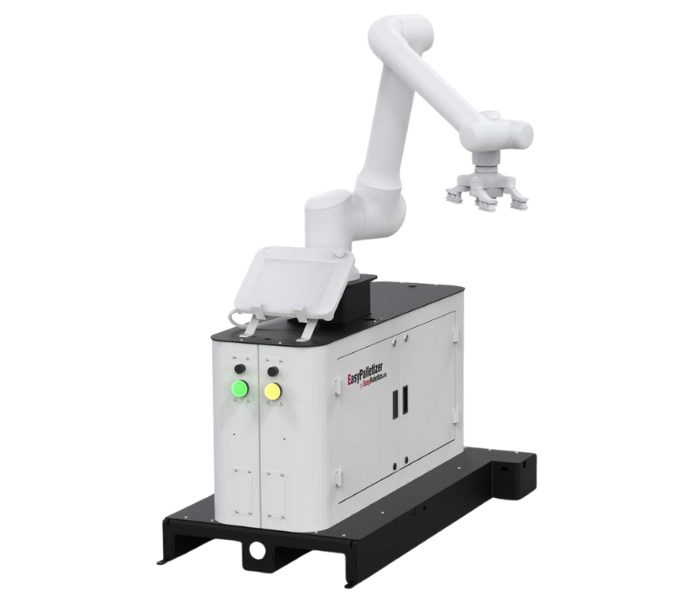
Four detection pins per pallet side confirm correct docking before palletizing begins
The Case for Stainless Steel: EasyPalletizer's AISI304 Configuration
EasyRobotics builds the EasyPalletizer — its dual-pallet cobot palletizing platform — in a dedicated AISI304 stainless steel configuration specifically for industries requiring high hygiene standards or corrosion resistance. This isn't a coated version of the standard unit; it's a distinct build for washdown and controlled-cleanliness environments.
What the Stainless Steel EasyPalletizer Offers
• AISI304 Stainless Steel Construction
Resists corrosion from washdown chemicals, moisture, and repeated cleaning cycles far more effectively than painted mild steel, maintaining a cleanable surface finish over years of daily sanitation routines.
• Dual-Pallet Design
Supports simultaneous palletizing operations across two pallet positions, keeping throughput high even in high-mix food and beverage packaging lines where changeovers happen frequently.
• Multiple Pedestal Heights
Available at a 710 mm base height, or with a fixed pedestal at 835 mm or 1200 mm, so the platform aligns with existing conveyor heights rather than forcing a line redesign.
• Reliable Pallet Detection
Four detection pins per pallet side confirm correct docking before palletizing begins, preventing misaligned loads — a meaningful concern when product traceability and case integrity both matter.
• Broad Cobot Compatibility
Works with Universal Robots, FANUC, Doosan, and Robotiq, so manufacturers can pair the stainless steel platform with whichever cobot brand they've already standardised on elsewhere in the plant.
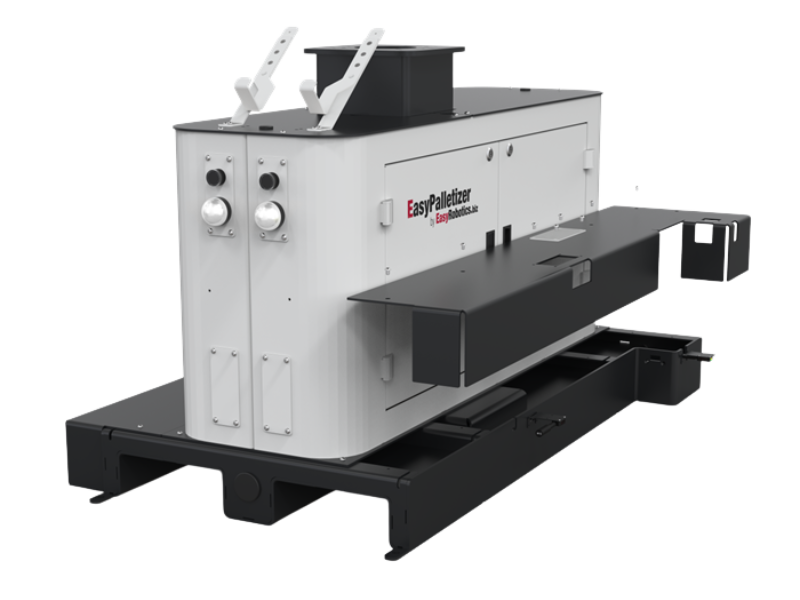
EasyPalletizer is deployed across pharmaceutical, food and beverage, electronics, and metals production lines
Where Palletizing Automation Pays Off Fastest in Food and Pharma
Not every packaging line has the same automation urgency. The strongest returns in food, beverage, and pharmaceutical settings tend to come from a specific combination of conditions.
• Repetitive Case Lifting
End-of-line palletizing is one of the most physically repetitive tasks on a packaging floor — the same lifting motion, hundreds of times per shift. This is also one of the highest sources of manual-handling injury claims in food and beverage manufacturing, making it a natural first automation target on safety grounds alone.
• High-Mix, Short-Run Packaging
Product lines with frequent SKU changes, seasonal packaging, or multiple pack formats benefit from a palletizer that can be reconfigured quickly between runs rather than a fixed, hard-tooled system designed around one case size.
• Contamination-Sensitive Production
Reducing the number of direct human contact points between finished product and the pallet lowers the opportunity for contamination — relevant wherever hygiene protocols are strict, from ready-to-eat food packaging to pharmaceutical secondary packaging.
✅ A Hygienic Palletizer Is the Right Fit If You Have…
• Regular washdown or wet cleaning cycles on the production floor
• Corrosion problems with existing mild-steel end-of-line equipment
• Frequent SKU or pack-size changeovers requiring fast reconfiguration
• Manual-handling injury concerns from repetitive case stacking
• A need to pair with an existing UR, FANUC, Doosan, or Robotiq cobot
Beyond the Palletizer: Building a Complete Hygienic End-of-Line Cell
Palletizing is usually one station in a longer packaging line, and EasyRobotics' modular platform is designed to combine with other stations without a custom integration project.
Load Transfer: The EasyPalletStation handles product transfer to and from mobile robots or conveyors ahead of the palletizing step, keeping product flow continuous between stations.
Flexible Configurations: The EasyPalletizer Flex and EasyPalletizer Pro extend the platform's capacity and configuration options for higher-throughput or more complex packaging lines.
Broader Automation: Because all EasyRobotics systems share a common modular design, a stainless steel palletizing cell installed today integrates cleanly with machine tending or dispensing automation added later — see the full product range for options.
Frequently Asked Questions
Conclusion
Robotic palletizing systems for food, beverage, and pharmaceutical production aren't a matter of taking standard automated palletizing equipment and hoping it survives the washdown schedule. They require a cobot palletizer built for the environment from the ground up — corrosion-resistant construction, fast changeovers, and a design that stays cleanable through years of daily sanitation cycles.
The AISI304 stainless steel EasyPalletizer was built for exactly that environment, giving hygiene-sensitive manufacturers the same dual-pallet throughput and cobot flexibility as the standard platform, without the corrosion risk that puts a generic palletizer's lifespan — and your next audit — in question.
Ready to Palletize Without the Corrosion Risk?
Talk to an EasyRobotics automation specialist. Get a tailored stainless steel EasyPalletizer quote,
a hygiene-compliant configuration, and a payback estimate — at no charge.