How CNC Machine Tending Automation
Reduces Downtime by 40%
A practical guide for manufacturers ready to automate CNC loading, cut idle time,
and achieve full ROI in under 8 months.
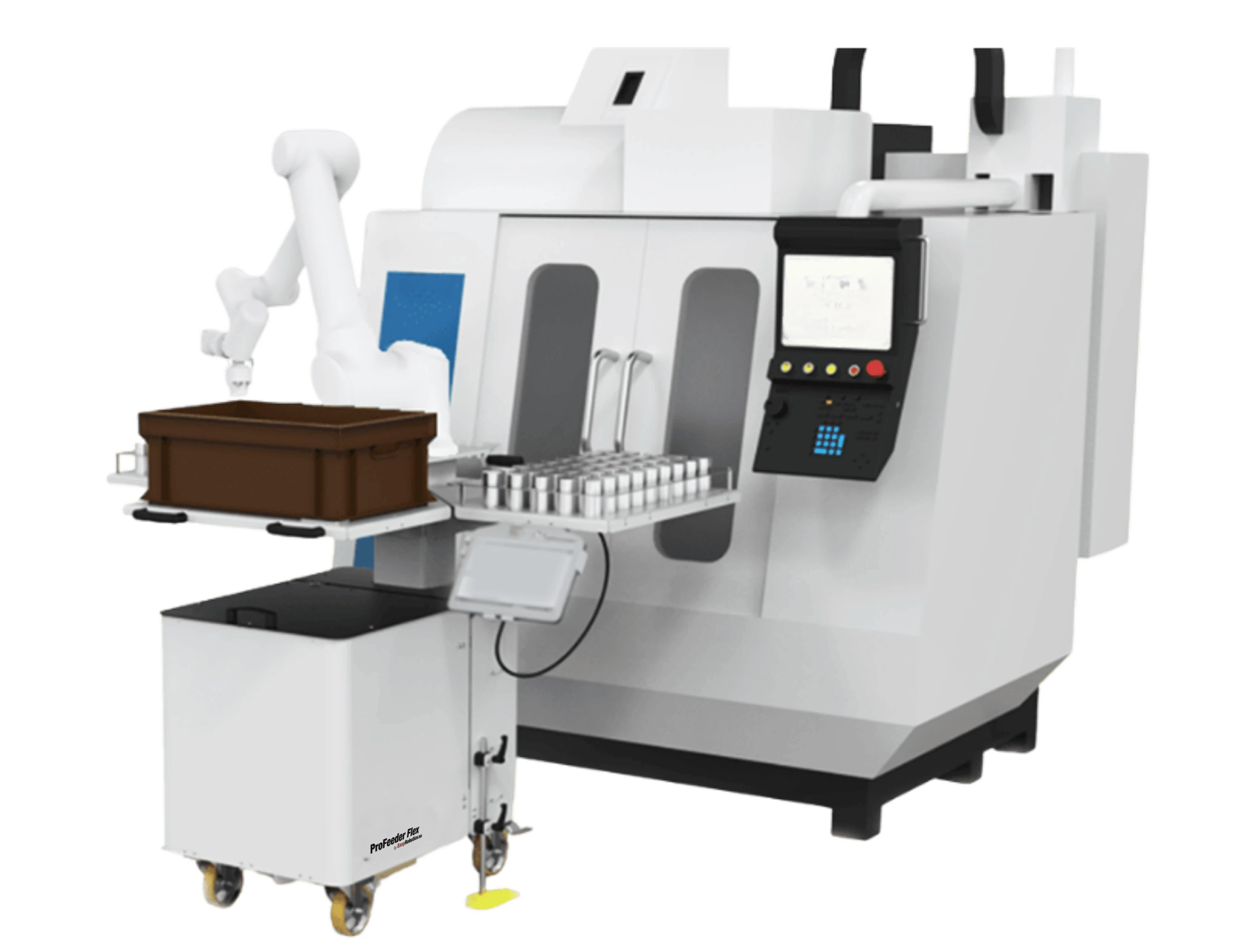
Walk through almost any small or mid-sized manufacturing facility and you will find the same scene: a CNC machine paused, waiting for an operator to unload a finished part and load the next blank. The machine is ready. The program is loaded. But nothing is happening — because the human is on a break, helping another machine, or managing the dozen other tasks that fill a production shift.
This waiting is expensive. Industry data consistently shows that CNC machines in traditional manual-tending environments operate at just 40–60% utilisation. The rest of the time, the spindle is silent. For a machine that cost €80,000 and runs across three shifts, that idle time translates directly into margin left on the table every single day.
CNC machine tending automation solves this problem at the root. By deploying a collaborative robot (cobot) to handle the repetitive loading and unloading cycle, manufacturers unlock the remaining 40% of their machine capacity — without hiring additional operators, redesigning their floor layout, or taking on significant capital risk.
"Partnering with EasyRobotics was the best move for our plant. Their ProFeeder made machine tending seamless and saved us hours of downtime every single week." — Mohammed, EasyRobotics Customer
What Is CNC Machine Tending Automation — and Why Does It Matter Now?
CNC machine tending automation uses a robot arm to perform the repetitive task of picking raw workpieces from a feeder or tray, placing them inside a CNC lathe or milling machine, waiting for the machining cycle to complete, and then removing and stacking the finished part. This cycle repeats hundreds of times per shift.
For years, this kind of automation was reserved for high-volume, low-mix production at large OEMs — operations running tens of thousands of identical parts per month. The economics only made sense at scale, and the integration complexity put it out of reach for smaller shops.
That changed with the rise of collaborative robots and modular feeder systems. Modern CNC machine tending solutions like the EasyRobotics ProFeeder are designed specifically for high-mix, low-volume production — exactly the environment most job shops and contract manufacturers operate in. Changeovers between part families take minutes, not hours. Programming a new part is accessible without dedicated robotics expertise.
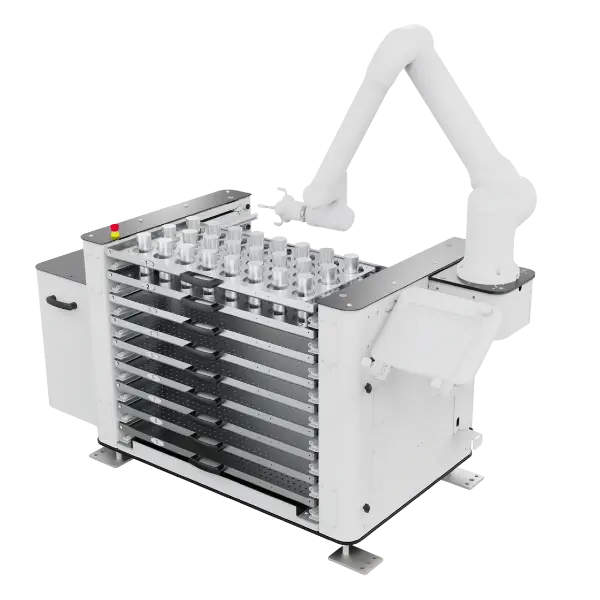
ProFeeder S — compact plug-and-play CNC tending cell with 5-tray system, supporting up to 150 kg per tray
The Real Cost of Manual CNC Machine Tending
Before examining the solution, it is worth being precise about the problem. Manual machine tending carries four distinct cost categories that rarely appear on a single line of a P&L — but together they define the true cost of not automating.
• Direct Labour Cost
An operator dedicated to tending a single CNC machine earns, on average, €35,000–€55,000 per year across Western European markets, including employer contributions. For three-shift operations, that figure triples. Automation redirects operators to higher-value tasks and dramatically reduces the headcount required per machine.
• Machine Utilisation Loss
Every minute a machine waits between cycles is lost capacity. If a machining cycle takes four minutes and manual loading takes two, the machine runs at 67% of theoretical capacity even with a dedicated operator. Add breaks, shift changes, and distraction, and real utilisation often drops below 50%.
• Quality Inconsistency
Human operators, especially late in a long shift, introduce variation. Parts are placed at slightly different orientations. Clamping force varies. The result is a higher rate of dimensional rejects and rework — costs that are difficult to quantify until a quality audit forces the issue.
• Recruitment and Retention Pressure
Machine tending is physically repetitive and mentally undemanding. It is one of the hardest roles to fill and one of the highest-turnover positions in manufacturing. Each departure costs €5,000–€15,000 in recruitment, onboarding, and lost productivity — a recurring cost that compounds over time.
💡 Quick Facts
• CNC machines in manual environments typically run at 40–60% utilisation
• Cobot automation consistently pushes utilisation above 85%
• Lights-out production (overnight, unattended) is achievable from day one with the right feeder system
• EasyRobotics customers report full ROI in 6 to 8 months on average
How EasyRobotics ProFeeder Solves the Machine Tending Problem
The EasyRobotics ProFeeder was purpose-built for the CNC machine tending application. Unlike generic robot arms mounted on custom pedestals, ProFeeder is a complete, pre-engineered cell that combines the cobot arm, a high-capacity tray system, and a modular mobile base into a single plug-and-play unit.
Key Features of the ProFeeder System
• Five-Tray High-Capacity System
Each ProFeeder S tray holds up to 150 kg of raw blanks, giving the system enough capacity to run unattended through a full shift or overnight. Mechanical magnetic locks secure each tray for consistent part presentation every cycle.
• Universal Cobot Compatibility
ProFeeder works with Universal Robots UR5e and UR10e, Doosan, FANUC CRX series, ABB, KUKA, and most major cobot brands. You are never locked into a proprietary robot ecosystem.
• Mobile, Non-Destructive Footprint
ProFeeder rolls on lockable castors. It can be moved to a different CNC machine in minutes, repositioned for a different job, or stored when not needed. No floor anchoring or machine modifications required.
• Same-Day Deployment
Most EasyRobotics installations are operational the day they arrive. The plug-and-play design eliminates the weeks-long integration projects that characterise traditional industrial automation.
• High-Mix Production Ready
Switching between part families is fast. ProFeeder's quick-change tooling and simple software interface let operators programme new parts without robotics expertise — keeping the system productive across your entire job book.
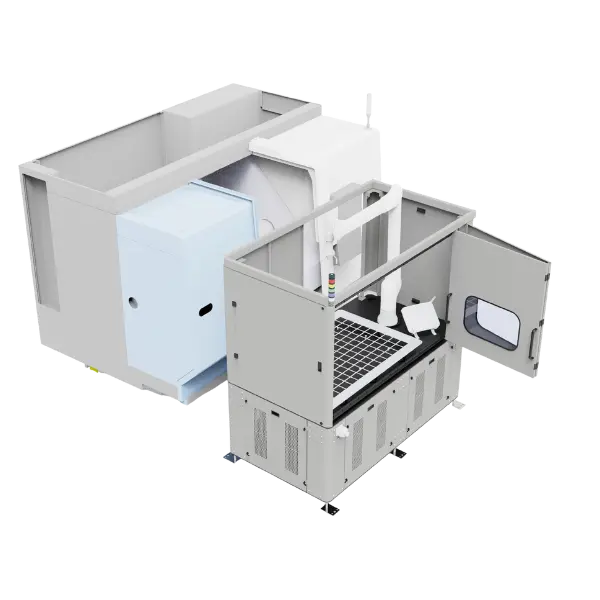
EasyRobotics modular automation systems integrate into existing production lines with minimal disruption
Understanding the ROI: A Realistic Calculation
The strongest objection to automation is usually the upfront cost. But the real question is never the price — it is the payback period. Here is how a typical ProFeeder deployment stacks up financially for a mid-sized job shop.
Scenario: A shop running two CNC lathes on two shifts, each tended by a dedicated operator. Average output is 120 parts per shift per machine.
After deploying two ProFeeder units — one per machine — the same machines run three effective shifts (including a lights-out overnight window) with a single operator managing both cells. Output climbs to 200+ parts per shift per machine. Labour cost for tending drops by 60%. Scrap rates improve due to consistent robot placement.
Across a typical European market, the combined labour saving and output uplift produces a net annual benefit of €80,000–€120,000 per machine. Against a ProFeeder investment of €35,000–€55,000 (cobot inclusive), payback lands firmly in the 6–8 month window that EasyRobotics customers consistently report.
Use the EasyRobotics ROI Calculator to run the numbers against your own shift structure, part mix, and labour costs. The tool outputs a payback month and five-year net benefit figure tailored to your specific operation.
"We saw immediate ROI. Machine utilisation went from 54% to 89% in the first month — and our operators are now doing work they actually want to do." — Tim David, EasyRobotics Customer
Is CNC Machine Tending Automation Right for Your Operation?
Cobot-based CNC tending delivers the strongest results in specific operating environments. Here is a straightforward checklist to assess fit for your facility.
✅ Strong Automation Candidate If You Have…
• Repetitive part families running 50+ pieces per batch
• CNC machines sitting idle during operator breaks or shift changes
• Difficulty hiring or retaining machine tending operators
• Parts with consistent clamping geometry (round, prismatic, or fixture-held)
• A desire to run lights-out or extended unattended production
• Multiple CNC machines that could share a single mobile feeder
If your production is extremely short-run (under 10 pieces per job with frequent geometric variation), or if parts require real-time human quality judgement mid-cycle, a customised automation solution may be more appropriate. EasyRobotics engineers are available to assess your specific situation at no charge.
Beyond Machine Tending: Your Broader Automation Roadmap
For many manufacturers, CNC machine tending is the first automation project — the one that proves the business case and builds internal confidence. Once operators see robots handling tending reliably, the conversation naturally expands to adjacent processes.
Palletizing: The EasyPalletizer automates end-of-line stacking, eliminating the physical strain of repetitive lifting and ensuring consistent pallet patterns. Customers report 30% output increases in the first month of deployment.
Welding Automation: The EasyWeld Station brings collaborative welding to fabrication shops of all sizes. Built around a precision Siegmund welding table, it delivers consistent weld quality across high-volume batches.
Flexible Tending Cells: For operations requiring a full safety enclosure, the FlexiGuard Tending Station provides a complete enclosed robot cell compatible with any CNC machine brand and all major cobot manufacturers.
Because all EasyRobotics systems share the same modular design language, each new addition integrates seamlessly with existing installations. You are building a scalable automation platform — not buying isolated machines.
Frequently Asked Questions
Conclusion
CNC machine tending automation is no longer a technology reserved for large-scale OEMs. With modular, plug-and-play systems like the EasyRobotics ProFeeder, manufacturers of every size can eliminate idle spindle time, reduce labour dependency, and build a production floor that runs reliably — day and night.
The combination of same-day deployment, universal cobot compatibility, and a 6–8 month payback window makes this one of the most compelling investments available to modern manufacturers. The factories that automate today are the ones that compete — and win — tomorrow.
Ready to Stop Leaving Capacity on the Table?
Talk to an EasyRobotics automation specialist. Get a tailored quote, a payback calculation,
and a deployment plan for your factory — at no charge.